Showing posts with label Wild Trout. Show all posts

Thursday, December 22, 2011

My Fall (Part 2)

Aside from my now job, there were a few other really notable positives in the fall, the most relevant one to my readers is that I caught my largest trout to this point.


I didn't have a tape at the time, but comparing it to the rod beside it, I estimate it to be a 22-24" tiger trout.  This is my third tiger, and it was an intense fight on my 4wt!

As usual, I took a break from the small streams and wild brookies when they decided it was time to spawn...


As I said, I made it to Erie to do some steelhead fishing...


And for the first time in my life, I went duck hunting.  A friend of mine invited me to do a few days of hunting with him, and now I'm hooked, and on a mission to get a few ducks around here on my own.  My first duck hunting trip was successful...


But subsequent trips have been a bit less so.  In any event, it's a new venture for me, and just like fly fishing, I don't expect lots of early success.  I'll be out again early tomorrow morning to try to get a few, but even if I don't get any, every trip out is one closer to the trip where it all finally clicks.  For now, I'm just enjoying learning something new.

A few weeks after my first duck hunting outing, I started my new job, and focused on adjusting to it for a few weeks after that.  Still, it couldn't have come at a better time, as it meant I could afford the gas and hotel room to make the drive up to Somerset, NJ for the 2011 International Fly Tying Symposium.  While I was there, I made sure to take plenty of photos...

...which you will all get to see in my next update!

That's all for now.  Merry Christmas to all my readers, and when I post again after the holiday, you'll have lots of fly pictures!

Tuesday, July 19, 2011

Summer Rainbows

Last Saturday, I managed to free up an entire afternoon for some trout scouting.  I keep a Google map of locations for fishing as a sort of 'To Do" list, with little markers in green identifying places that have been good fishing spots in the past.  Yellow markers indicate places that I've heard about or had recommended to me, or simply found on the map and thought that it might hold wild trout.  These markers are usually accompanied by short notes such as, 'Look for parking and access.' or , 'Low water mid-summer, check back in spring and fall.'

Usually, I don't have the luxury of time to plan out a scouting trip to check out these places, but when I do, it's always a learning experience.  Saturday was one of those days.

I had made plans to attend a picnic later in the evening in a somewhat remote area.  Lucky for me, that remote area was host to several yellow markers on my map.  I picked out four markers and planned out a rough route in my head connecting them.  I wanted to hit the most promising ones first, even though that often means I won't get to the entire list.

When I got to the first location, there were big yellow posted signs every ten feet, making it abundantly clear that visitors were not welcome.  Some guys will track down the landowner to get permission, but I take the signs to mean that they really don't want people in there.

The second area simply had no convenient location to pull off the road.  A steep drop-off to the stream would have been a challenge to navigate, but there were no spots where I'd feel comfortable pulling off the road and trusting that nobody would slam into my parked car.  A bit frustrated, I went to the third spot.

The route to this spot took me on a bridge over my 'backup option': a large, rocky creek that has managed to humble and stymie me repeatedly.  I know there's big trout in it.  Hell, I've seen the big trout...but with just one notable exception (a chunky brown), this creek has limited me to nothing but smallish 6-7" fish.  For a small stream, that isn't bad, but when I know that an 18" trout isn't terribly rare on a given stream, six or seven inches of trout isn't much of an accomplishment.


The third spot looked like a good spot on the map, but in person, it was little more than a few damp rocks in a ditch.  In fact, the bridge over it was the only place that it wasn't completely covered by weeds and saplings.  There might have been a trout in there, but even dapping was impossible with the thick vegetation.

Finally, the fourth spot seemed worthy of a try. Actually the same stream as the backup option, this was simply a point much farther upstream than I'd ever fished, where the waterway was much smaller.  There was a handy pull-off just before the bridge and I quickly got out and walked down to the water.

While it was obviously low, the creek looked fishable, and I returned to my car to gear up.  A few minutes later and I finally got to my first cast of the day, hours after I left home.

This was the second outing for my new ultralight rod (which I'll discuss more fully in a later post), and I was still having trouble adjusting to the fast action in such a light stick.  Still, I managed a few decent casts and drifts...but failed to persuade any fish.  Twice, I was rewarded by quick, splashy rises, but I suspected they were minnows, not trout.

As I worked my way upstream, I was disappointed again, as I happened upon a deep, wide, slow section, too deep to wade and to steep and muddy to go around...just a few yards from where I entered.  Disappointed once again, I headed back for the car, and from there, my backup option.

Blue-lining, or searching the map for possible wild trouting locations, then following up with visits, is a venture often met with heaps of disappointment, but it usually pays off just enough to keep a few of us coming back for more.


Well, eventually, I got back to my backup creek, got my pack, and headed for the water.  Just as I entered, though, I heard a noise and looked up to see a guy and his young boy fishing and playing in the next pool up.  Had it been a lone fisherman, I might have been annoyed, but I was glad to see the young kid out with his dad.  Still, I had to make yet another decision.  To fish the lower reaches meant walking downstream then fishing my way back up.  Upstream would mean getting out and skipping over where the guy and his boy were, but would take me to water I'd only ever fished once before, so I decided to go that route.

As I walked along the train tracks that paralleled the stream, I noticed a small feeder creek that I'd only ever seen at the mouth where it emptied into the main waterway.  At this point, the light bulb came on and I decided to fish the feeder instead.  Dropping down from the railroad tracks, I started drifting the tricky currents in the rocky streambed, methodically covering every drift in a pool or riffle before moving up to the next.  Although I didn't realize it until later, I must have started to really get the feel for my new fly rod, because I noticed myself getting the drift I wanted more and more often, without the exasperating misses and splashdowns.  Another quick way to improve your casting is to fish any small stream.  You'll either improve, or lose every fly you carried in to trees, roots, branches, and shrubs.  Speaking of shrubs, the wild rhododendron was in full bloom...


As I went up, I started getting a few rises, and as I got used to the rod, rises turned into fish landed...and jus tlike that...I'd discovered a new stream for wild rainbows...

First trout on the new rod.  Not a bad way to break it in.

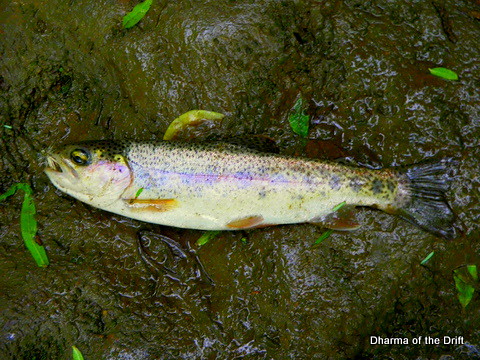
I love the fins of the wild bows...maybe even more than those of the wild browns and brookies.

Love the pink stripe that looks like someone painted it on there...

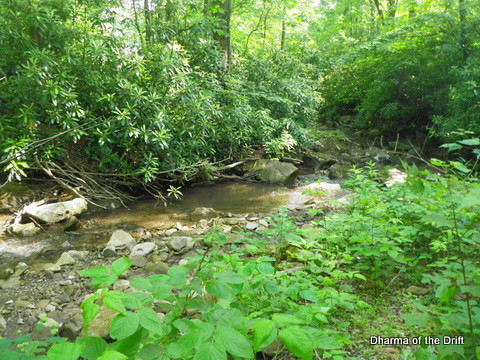
As always, the surroundings are beautiful...

A little farther up, I came to a bend in the stream.  At this bend, there was an extremely large, deep pool for a stream of this size in this rocky terrain.  It also had a unique feature: a rock island out in the middle of the pool.


Almost no spots on this one.  More than the browns and brookies, I think wild bows display the most variance in appearance from fish to fish in the same stream.

Terrible photo, beautiful fin.

This may be a personal best wild bow...not sure.  He was pushing 8".  Not sure what happened to his gill, though.

Friday, July 15, 2011

Personal Best Wild Trout

Short post today, but it's one I'm proud of.  I got out to chase wild trout over the weekend, and decided to revisit a small but nice stream I hadn't fished since the pre-runoff conditions.  I really like the lower sections of this stream because it has all the challenging characteristics of a typical small stream, with one major difference: as it enters the lower section, the stream widens and passes through some mature forest, meaning there's plenty of room for casting.  This is a luxury that a small stream fisherman doesn't often enjoy.

Still, that isn't to say that the stream is easy, by any means.  A good one to take a beginner to?  Sure.  There's no shortage of textbook riffles and pools.  But between the obvious spots lie some tricky undercuts with low-hanging branches, hard-to-reach seams, and those drifts that would be easy, except you can't position yourself in the logical place because you've got to be stealthy.

I was working my way up to a pool that had a pool that was long enough to create one of those stealth-related difficulties.  The head of the pool has a few boulders scattered through it, making for great fish-holding water, but while it'd be easy to cover that water from up close, you'd spook every fish to get there.  So the alternative is fishing from the bottom of the pool and making 35-45 foot casts (do-able, but a tricky proposition with a short 1wt nonetheless) up into the boulders, making 2-3 foot drifts, and casting again.  Making things even more interesting, most of your drifts here are only visible for a foot or two before the current takes your fly to the opposite side of a rock from where you're standing.

It was on one such drift, toward the outside of the pool, that my fly drifted to the opposite side of a moss covered boulder.  Just as I was about to lift my line for another cast, I noticed a few drops of water and ripples coming from behind the rock, so I set the hook with a quick snap and my hunch was proven by the resulting head shake.

The head shake assured me of something else, too: this was not another 5" native, which usually come splashing across the surface.  No, this fish immediately pulled me the the bottom of the pool and stayed there, the green blank of my 1wt flexing deeper than it has in months.

After a spirited battle, I pulled the fish up to a partially submerged rock for a few quick photos...


And soon after, his release...


Thursday, July 7, 2011

Want Wild Trout, Will Travel

As promised, here's some photos from recent outings with my buddy Sam, in search of wild trout.  While some like to add narrative, often, I find that the photos speak for themselves.  So without further ado, here are the goods:

In this hole, Sam found a stocked brown that had wandered up from the creek that this blue line emptied into.  We were there primarily for wild trout, but who could resist the opportunity to take a larger fish on a light line?  Sam managed to turn the fish, but never did bring him to hand.  There's always next time, I suppose.

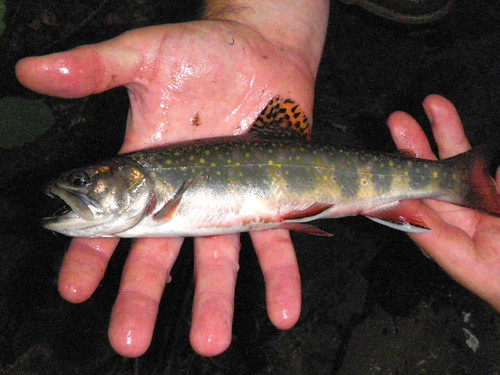
This is what we were after...check out that yellow spot at the corner of the mouth.  That's on the fish, not a trick of the camera.  Not sure what's going on there, as I didn't notice it until I uploaded the photos from my camera.  I took several shots of this fish, though, and the spot is consistent throughout.

Brook trout are way prettier than strictly necessary.

This was as far upstream as we went on this particular stream.  That hole is surprisingly deep, considering the typical nature of the streams in the area.  We'd have gone farther, but there were some posted signs about (even though according to sources, it should be public land...and anyone renting has no authority to prevent passage...still have to look into that one...)

A few days later, Sam and I met up again to further explore some water we'd only briefly visited in our last adventure.  I had to take care of some errands at home first, but Sam got a good early start, so I found myself hiking to the water to find some indication of whether he was up or downstream from the access.  Along the way, I found some interesting fauna...

I think this guy is a millipede as opposed to a centipede, but being unsure, I wasn't about to risk a painful sting by disturbing him.  I saw a few more like this later in the day too.  Pretty exotic-looking for southwestern Pennsylvania.

Far less exotic, this is still the biggest snail I've ever seen in the woods.

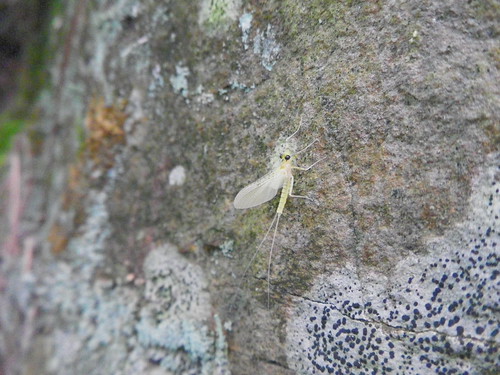
Cahills were hatching sporadically, which is perfect for a small stream, as the naturals are big enough to get the trout looking up for food, but not so heavy a hatch that they really key on anything specific.

Not sure what left this shuck, though I suspect it's a dragonfly, from the shape of the head.


Friday, April 1, 2011

6 Key Features of a Small Stream Dry Fly

Fishing small streams for wild trout presents a different set of challenges than most typical fly fishing: the casts are short and the drifts are shorter, the conditions are crowded, stealth becomes a huge factor, and often a decent cast will involve throwing line across three or four separate stream features and currents, to deliver a fly within a few inches of a rock, under branches hanging just a foot or two over the water.

This type of fishing places many additional demands on an angler, but also affords him the opportunity to meet those challenges by giving him freedom in other areas.  Fly selection shows this better than many other aspects of fly fishing, and a blueliner's fly box, while it may look fairly standard, is carefully tailored to this kind of fishing.

In simplest terms, there are six essential elements that make any dry fly great (or not so great) on a small stream.

6. Buoyancy

This may seem like a no-brainer, but it's an extremely important feature.  By saying that a small stream dry must be buoyant, I'm saying it needs to float on the water, not in it.  You want your fly's body to be totally up, out of the water, seemingly bouncing across the surface.

Compared to a standard catskill tie, this Adams has an extra helping of hackle.

There are a few ways to accomplish this, using foam or other buoyant synthetics, using a hollow hair like deer or elk, using a heavily greased fly, or, the most common method: tying your normal standard dry patterns with extra heavy hackling.  Much like 'western-style' dries, a small stream dry benefits from a few extra turns of hackle.  Flies like the Bivisible, which incorporate a lot of hackle just from the pattern are also great choices for small streams.

Also incorporated with buoyancy is making sure that the materials will accept a healthy dose of paste floatant as well.  Hackle will soak up it's fair share, as will most dubbings and hair.  Things like foam, quill/biot bodies, and most synthetics don't accept much floatant.

5. Water Resistancy

With all the currents and obstacles in a small stream, any dry fly is going to get dunked from time to time, regardless of how high it rides.  Its resistance to the water is what will set a great fly apart from one that is more trouble than it's worth to keep it floating properly.

This property depends on two things: the way the bodies are tied and the material used.  For materials, you want things that won't wick moisture into the core of the body.  Things like foam, antron, or naturally water-resistant fur like muskrat or beaver.  As far as method, you want a body that is wrapped or dubbed as tightly and evenly as possible.  Bushy, buggy dubbing will allow the fly to soak up water through capillary action, which will eventually sink it.

4. Quick Drying

No matter how high your fly rides, or how waterproof it is, at some point (probably sooner than you think), that fly will be completely waterlogged.  At this point, you'll have to dry it out again before it'll float correctly.  Of course, a few good crisp false casts will wring a good deal of that water out of your fly, but after that, you've got a few options.

First, you can try any number of fly-drying products: amadou pads can squeeze a fly and absorb the moisture that comes out, powdered desiccants (like Frog's Fanny) are brush on powders that do a great job of really pulling every drop of moisture out of your fly, and recently, I've started seeing a few 'spray-on' drying agents, that come in a pump bottle.

All of these products work, to an extent (I carry powdered desiccant and have been trying a few spray-ons as well).  Try the false cast until it doesn't work, as its the fastest method, then after that, I usually dust it with Frog's Fanny, false cast it again to knock excess powder off, then spray a shot or two of a liquid dryer/waterproofer on, and false cast again a few times, then reapply my paste floatant.

Eventually, however, the water will work its way down to the thread and the insides of your fly, and no amount of false casting or chemical will revive it.  At this point, clip it off, hang it on your fly patch, and let it air dry, while you tie on a fresh one.  Naturally, it's a good idea to have several copies of each of your best patterns.

3. Durability

Another great reason to have multiples of your best flies is because if you're on a small stream, you're bound to surrender a few flies (or a lot of flies) to trees, rocks, bushes, fallen logs, and whatever else happens to be close at hand.  The ones you do manage to recover often are a little worse for the experience, with messed up wings, twisted hackle, and crinkled hair.

On a good day of fishing, the fish themselves will shred a fly to bits, too, and a well-chewed fly is a thing of beauty.

The best way to delay the inevitable is to concentrate on tight ties at the bench.  Practice technique, use minimal thread, use a drop of head cement if necessary (but if your technique is good enough, you shouldn't need it).  In short: you want bulletproof flies when you start out.  There's nothing you can do to increase the durability of a fly once you're on the water.

2. Bugginess

I know I said up above that a buggy-dubbed fly would absorb water.  That's true, it will, but there's other ways to get that look that won't turn your fly into a sponge.  Hair wings, heavy palmered hackle, and materials  like peacock herl that will break up the outline of your fly are all safe bets.

The reason for this is because you want to be able to minimalize your fly selection while making sure you're covered for most situations.  In this way, you can tie an elk hair caddis in light tan, olive, medium brown, and black...all in a size #14, and be covered for tan caddis, early stoneflies, mosquitoes, BWOs, and olive caddis.

When you're on a small stream, it's usually good to dumb down your entomology skills, and instead of thinking in terms of 'isonychia', 'october caddis', and 'baetis', start thinking in terms of 'little', 'big', 'light', and 'dark'.

1. Visibility

The most important aspect of a small stream dry fly is that it is visible.  To you, not the fish.  The fish will be able to see any fly, no problem, but in the twisting, tumbling currents of a mountain stream, it's easy to lose track of your fly.  You want to make sure that you're looking at the fly when that brookie rises to it.

In this vise, this means light colors and bright colors.  For any hair wings, I use bleached elk or deer.  In other flies, you can use antron yarn in fluorescent green, pink, and orange, as well as brightly colored foam.  For parachutes, both bright and bleached white turkey flats and calf body hair are used with great results as well.

Wednesday, February 23, 2011

Kindred Spirit from the Left Side

In my internet wanderings, I came across Adipose Fin, a blog run by a guy with the same interests in fishing as myself: small streams, wild fish, ultralight gear...but not so hung up on it that it becomes how he defines himself.

Adipose Fin operates out of California, making for a highly noticeable change in scenery compared to the flora and fauna you may see in pictures here at Dharma of the Drift, based in Pennsylvania.  It's a refreshing contrast, and a subtle (and photogenic) reminder that there's lots of little streams out there, waiting to be discovered.

Granted, there hasn't been any new posting for some time, but what IS there should be enough easy to read content and eye-catching photography to help tide any small stream angler over just a little closer to spring.

Monday, August 9, 2010

Mid-summer's Afternoon Dream

A few weeks ago, a good soaking rain filled and cooled the streams around here.  Naturally, that also meant that nearly all of these streams were the color of coffee & cream.  Luckily, at least one of my favorite little wild trout streams was fishable, and I ended up having a great day for July.  It was good to put a bend in the 1wt again, and to bring a few fish up top after weeks of swinging & stripping streamers for smallies.  Here's a few pictures, to prove the story:


This is what most of the streams looked like.


Until I found a little slice of paradise.


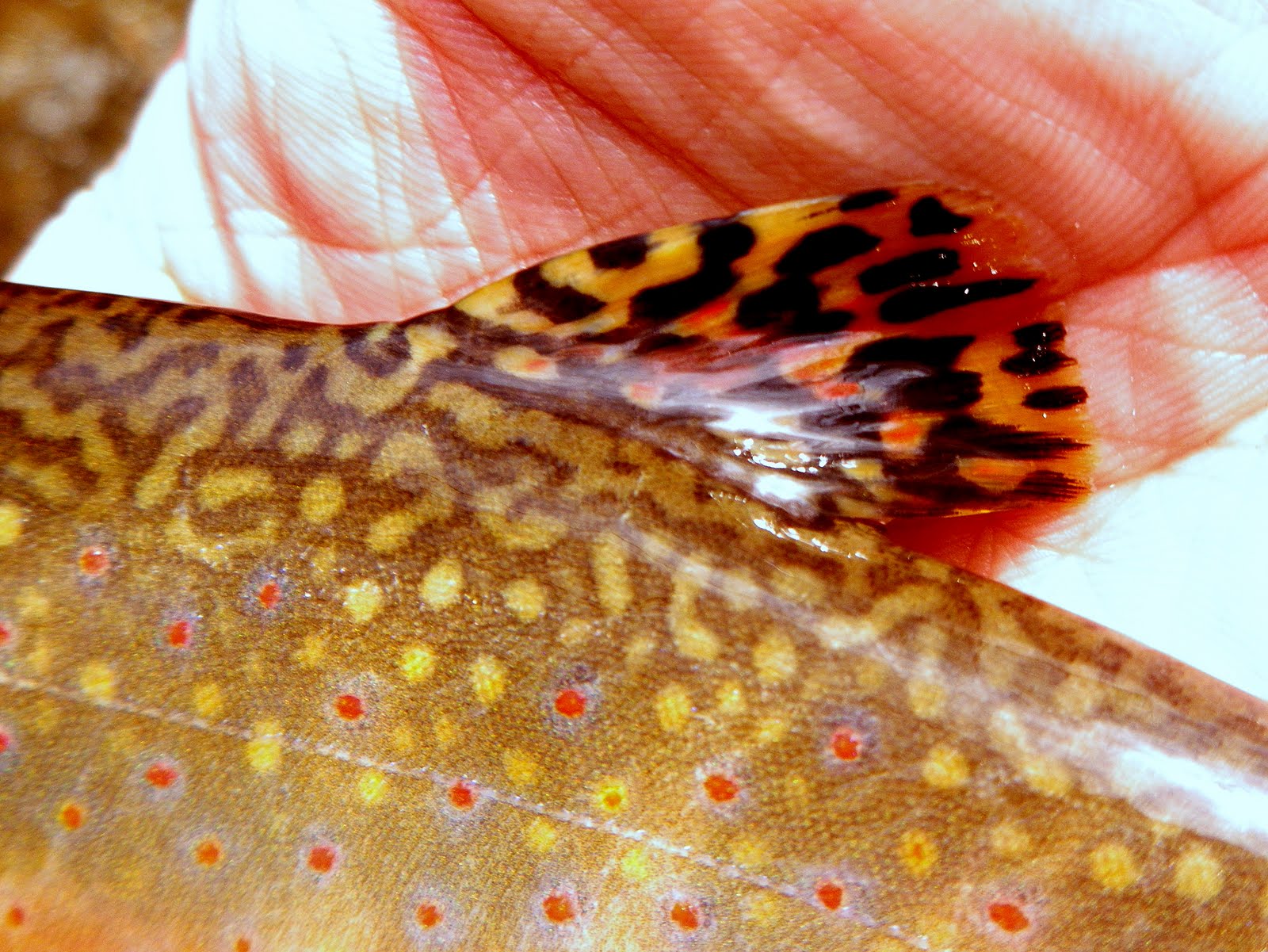
Check out those fins!

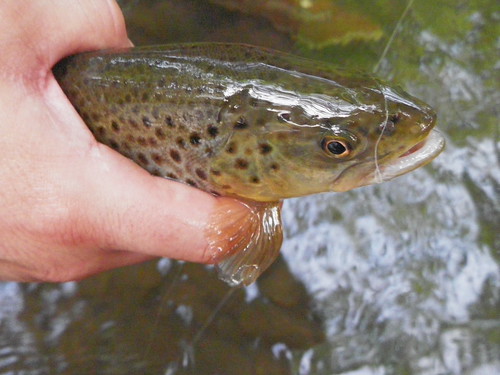
Holdover from the spring stockings, methinks...

Wednesday, June 23, 2010

Wild Trout Weekend

This past Saturday, I met a friend of mine to go fishing for small stream wild trout on dries.  We ended up having an awesome day, and while we didn't keep count, we estimated that we probably combined for about 50 trout brought to hand, and we both also missed our fair share.  We also both got the PA trifecta: a brookie, brown, and rainbow, all in the same day...though not form the same waterway.  It can be done, and I hope to accomplish it this summer, but we had a blast with the fish on two different streams on Saturday.

This entry will be more eye-candy, and less words, so take a look at the pics and enjoy...


This is what we were after...
Cahills were coming off, but very sporadically.  
Ironically, this was a good thing, as it kept the fish open-minded, not keying on the hatch.
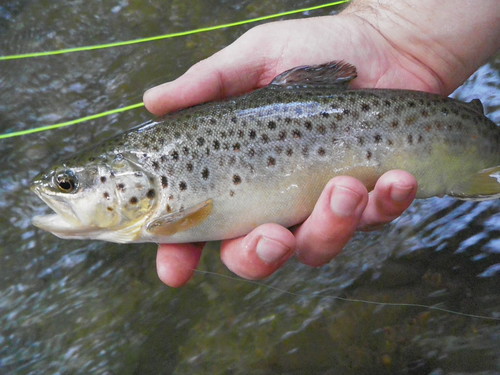
My buddy's largest brown of the day.  
Now that I'm looking at it, it could be a stocked fish that wandered up into the little stream.

Tried some underwater shots.  
Getting the hang of it, but still have a long way to go...


My friend was cleaning up on a light Wulff I tied up the night before, while I took trout on a Stimulator.


The last fish I caught was a beauty.  A 12" wild brookie.
Unbelievable colors.

The release.

Well that's it for now.  More pics from this trip in a future update.  But that should be enough to get your envy going.  This weekend I'm planning on hitting bigger water for bigger fish.  Hopefully, with some success, great pics should follow!

Monday, June 14, 2010

Chasing Wild Trout

The definition of 'small stream' varies widely from fisherman to fisherman, but I think that this little one would qualify on anyone's list.  This is 1wt water...


Light lines, light tippet, creative casting, and slow, stealthy approaches are the name of the game here.  I spooked more fish than I caught, but it was nice to get back to truly wild trout.  It's a very different kind of fishing, compared to the typical trout fishing experience here in PA.  You don't need a perfect cast or drift, you don't need to flawlessly match the hatch, and the fish are generally voracious little creatures, very willing to attack any vaguely buggy-looking imitation you throw their way.  The challenge comes in the form of the crowded surroundings, almost never open enough for a proper cast...and the spooky, wary nature of the fish that sends them for cover if they spot you.

A wise angler is always keeping in mind where his shadow is being cast, making sure that it is away from the water he intends to fish.  Also, its a good idea to walk slowly and softly, as even the vibrations in the ground caused by careless walking might spook a fish.

Crouching or kneeling is often a good idea as well, for two purposes.  First, you will cast less of a shadow, and stay out of a fish's view better from a lower position.  Second, it increases your casting room ever so slightly, which, in this type of situation, can be the difference between a tangle in a tree that will spook every trout in sight and a well-placed cast that lands you a fish.

I ended up with three fish yesterday afternoon, exploring a new stream I'd never visited before.  I found a decent access point, and for the most part stuck pretty close to that area the whole time.  Next time I visit, I'll probably venture farther downstream, as it looked like the stream got a bit wider down there.

Twitter Delicious Facebook Digg Stumbleupon Favorites More

 
Top Web Hosting | manhattan lasik | websites for accountants