Showing posts with label Beginner. Show all posts

Friday, April 1, 2011

6 Key Features of a Small Stream Dry Fly

Fishing small streams for wild trout presents a different set of challenges than most typical fly fishing: the casts are short and the drifts are shorter, the conditions are crowded, stealth becomes a huge factor, and often a decent cast will involve throwing line across three or four separate stream features and currents, to deliver a fly within a few inches of a rock, under branches hanging just a foot or two over the water.

This type of fishing places many additional demands on an angler, but also affords him the opportunity to meet those challenges by giving him freedom in other areas.  Fly selection shows this better than many other aspects of fly fishing, and a blueliner's fly box, while it may look fairly standard, is carefully tailored to this kind of fishing.

In simplest terms, there are six essential elements that make any dry fly great (or not so great) on a small stream.

6. Buoyancy

This may seem like a no-brainer, but it's an extremely important feature.  By saying that a small stream dry must be buoyant, I'm saying it needs to float on the water, not in it.  You want your fly's body to be totally up, out of the water, seemingly bouncing across the surface.

Compared to a standard catskill tie, this Adams has an extra helping of hackle.

There are a few ways to accomplish this, using foam or other buoyant synthetics, using a hollow hair like deer or elk, using a heavily greased fly, or, the most common method: tying your normal standard dry patterns with extra heavy hackling.  Much like 'western-style' dries, a small stream dry benefits from a few extra turns of hackle.  Flies like the Bivisible, which incorporate a lot of hackle just from the pattern are also great choices for small streams.

Also incorporated with buoyancy is making sure that the materials will accept a healthy dose of paste floatant as well.  Hackle will soak up it's fair share, as will most dubbings and hair.  Things like foam, quill/biot bodies, and most synthetics don't accept much floatant.

5. Water Resistancy

With all the currents and obstacles in a small stream, any dry fly is going to get dunked from time to time, regardless of how high it rides.  Its resistance to the water is what will set a great fly apart from one that is more trouble than it's worth to keep it floating properly.

This property depends on two things: the way the bodies are tied and the material used.  For materials, you want things that won't wick moisture into the core of the body.  Things like foam, antron, or naturally water-resistant fur like muskrat or beaver.  As far as method, you want a body that is wrapped or dubbed as tightly and evenly as possible.  Bushy, buggy dubbing will allow the fly to soak up water through capillary action, which will eventually sink it.

4. Quick Drying

No matter how high your fly rides, or how waterproof it is, at some point (probably sooner than you think), that fly will be completely waterlogged.  At this point, you'll have to dry it out again before it'll float correctly.  Of course, a few good crisp false casts will wring a good deal of that water out of your fly, but after that, you've got a few options.

First, you can try any number of fly-drying products: amadou pads can squeeze a fly and absorb the moisture that comes out, powdered desiccants (like Frog's Fanny) are brush on powders that do a great job of really pulling every drop of moisture out of your fly, and recently, I've started seeing a few 'spray-on' drying agents, that come in a pump bottle.

All of these products work, to an extent (I carry powdered desiccant and have been trying a few spray-ons as well).  Try the false cast until it doesn't work, as its the fastest method, then after that, I usually dust it with Frog's Fanny, false cast it again to knock excess powder off, then spray a shot or two of a liquid dryer/waterproofer on, and false cast again a few times, then reapply my paste floatant.

Eventually, however, the water will work its way down to the thread and the insides of your fly, and no amount of false casting or chemical will revive it.  At this point, clip it off, hang it on your fly patch, and let it air dry, while you tie on a fresh one.  Naturally, it's a good idea to have several copies of each of your best patterns.

3. Durability

Another great reason to have multiples of your best flies is because if you're on a small stream, you're bound to surrender a few flies (or a lot of flies) to trees, rocks, bushes, fallen logs, and whatever else happens to be close at hand.  The ones you do manage to recover often are a little worse for the experience, with messed up wings, twisted hackle, and crinkled hair.

On a good day of fishing, the fish themselves will shred a fly to bits, too, and a well-chewed fly is a thing of beauty.

The best way to delay the inevitable is to concentrate on tight ties at the bench.  Practice technique, use minimal thread, use a drop of head cement if necessary (but if your technique is good enough, you shouldn't need it).  In short: you want bulletproof flies when you start out.  There's nothing you can do to increase the durability of a fly once you're on the water.

2. Bugginess

I know I said up above that a buggy-dubbed fly would absorb water.  That's true, it will, but there's other ways to get that look that won't turn your fly into a sponge.  Hair wings, heavy palmered hackle, and materials  like peacock herl that will break up the outline of your fly are all safe bets.

The reason for this is because you want to be able to minimalize your fly selection while making sure you're covered for most situations.  In this way, you can tie an elk hair caddis in light tan, olive, medium brown, and black...all in a size #14, and be covered for tan caddis, early stoneflies, mosquitoes, BWOs, and olive caddis.

When you're on a small stream, it's usually good to dumb down your entomology skills, and instead of thinking in terms of 'isonychia', 'october caddis', and 'baetis', start thinking in terms of 'little', 'big', 'light', and 'dark'.

1. Visibility

The most important aspect of a small stream dry fly is that it is visible.  To you, not the fish.  The fish will be able to see any fly, no problem, but in the twisting, tumbling currents of a mountain stream, it's easy to lose track of your fly.  You want to make sure that you're looking at the fly when that brookie rises to it.

In this vise, this means light colors and bright colors.  For any hair wings, I use bleached elk or deer.  In other flies, you can use antron yarn in fluorescent green, pink, and orange, as well as brightly colored foam.  For parachutes, both bright and bleached white turkey flats and calf body hair are used with great results as well.

Tuesday, March 8, 2011

Wisdom for the Intermediate Tyer

I stumbled across three old, dusty links in the depths of my Delicious account last night, and decided to re-read them.  Once I'd finished, I realized how much truth, knowledge, and experience the writer managed to cram into three short blog posts.

It's about that difficult fly-tying transitional stage, starting just at the end of your last lesson (assuming you got some kind of a lesson, whether from a mentor, fly shop, website, book, or whatever), and it ends right about the time you can consistently crank out a few dozen dries, nymphs, or streamers that look totally identical, are well proportioned, with none of the ugly little imperfections.

...if...that is...you get to that point.

Many tyers seem to do their class, learn a dozen patterns or so, and settle in for the long haul, tying buggers and hares ear nymphs for the rest of their days, with the same trapped hackle fibers, crooked tails and crowded eyes as the first ones they cranked out.  Others push themselves to learn a few more patterns, usually the ones they fish most, and usually manage to master them....with the same bent tails, mangled hackle, and crowded eyes.

True, all of these flies will catch fish.  That isn't really the issue.  And if you don't have the desire to not only tie more flies but to also tie better flies, then this is all the farther you'll likely progress.  If, however, you have the desire to progress beyond the realm of one angler I know (who once answered my question of what they were taking by the reply: "They're taking my ties, so they must be keying on cripples."), then the following articles and the 9 tips they contain will be the foundation for "Fly Tying Grad School".

Part One, Two, and Three of Singlebarbed's tutelage is packed full, pressed down, and overflowing with simple and not-always nice truths of tying.  Among them, he starts off with the cold truth:

Refining your tying for the critical gaze of other fishermen will make your flies sturdier. All the painful lessons you’re about to learn are lost on fish, fish are stupid, lack artistic sense, and eat cigarette butts.

Then goes into the lessons proper.  Not far into the lessons, comes this nugget which really, is the core message:

Flies don’t wind up with proper proportions by accident, and tail, body, thorax, and head are all mapped in your mind before thread touches the hook. 

He not only tells you 'what' but also 'why', which is an essential part of the learning process for me, without which, any lesson is only so much missed nap time.  In any event, if you're a beginner tyer interested in taking your craft to the next level, this should be required reading.

Thursday, March 3, 2011

Ten Tips for Fly Fishing and Photography Alike

The more I acclimate to the photography community, and the more people and situations I encounter in my fishing adventures, the more I realize why these two seemingly completely different hobbies have appealed to me.  Though the methods and end results are very different, the mindset, personality, and creativity required of fly anglers/tyers and photographers is surprisingly similar, as is the tradition behind each.  This means that many generalized tips, tactics, and suggestions are equally valuable to both the fly angler and the photographer...and doubly valuable to those of us who combine the two.

What follows are some bits of wisdom I've picked up from folks who've been at it (both the fishing and the snapping) far longer than I have...and in my own adventures, these are the bits of wisdom that have proven true time and again.

Note: For me, fly fishing and fly tying are so inextricably linked, that I consider them both to be under the broad banner of fly fishing...at least for this post.  I may distinguish between the two, but in many cases I'll just say fly fishing, and the tying will be implied.  Kind of like how I usually don't use 'he or she' or 'him or her'...I just pick one and go with it.

Without further ado...

1. There's no substitute for good form.


From your first casting lesson or the first time someone mentions the rule of thirds, developing good form is the foundation upon which any fly angler or photographer builds their talent and skills.  Often, the failure to establish good form early on not only deprives the beginner of basic skills, but also tends to become a perennial source of frustration, as they spend most of their learning in developing pseudo-skills to address the challenges that might have been easily avoided by developing good form in the first place.

The fly fisher that fails to develop a good basic casting technique will figure out, on their own, all sorts of ways to compensate for their tailing loops, dipping rod tip, and lack of crisp movement.  Unfortunately, these are poor substitutes, and while they might do okay on a local pond or small stream, as soon as they get to bigger water where 50+ foot casts are necessary...or run into a stiff breeze, all the 'casting crutches' in the world won't get their fly to the fish.

This is why it's so important for a beginner to take a class, find a mentor, or even read a book early on.

2. It's you, not the kit.


Closely related to the beginner who lacks solid fundamentals, is the beginner, frustrated, who blames his lack of success on the piece of equipment in his hands.  Sure, it's probably cheap entry-level gear...maybe even used and bought (or handed down) second-or-third-hand from a previous owner.  Even if new, it's probably either a no-name unit, or the bottom-rung offering of a more reputable name.  They got it because the man in the shop said it'd do everything they needed it to do, but now they're not so sure.  After all, they've been using it for a few weeks already and have absolutely nothing to show for it.  If only they had the advanced model with all the bells and whistles, they'd be capable of results beyond their wildest dreams...

I've worded the above to be equally applicable to both fly fishing and photography, and it's one of the best things to keep in mind in beginning either pursuit.  The 'bells and whistles' of advanced camera bodies aren't meant to make the photography itself easier, in fact, usually beginners are struggling because they can't handle the bells and whistles they've already got.  And that new fast action, high-modulus, nano-silica resin fly rod, while admittedly sexy, is meant for advanced casters, and you'll probably actually be in a worse situation than you are with your entry level rod.

I actually learned this humbling lesson not in fishing or photography, but music.  Years back I was taking guitar lessons, and after a particularly frustrating session, I voiced my desire to upgrade.  In response, my teacher grabbed my guitar and proceeded to play some absolutely beautiful music.  After a moment, he handed it back and said, simply, "Seems okay to me."  Point proven.

3. Old gear/methods/ideas are still around for a reason.


And that reason is because they work.  Really well.  Very often, if not all the time.  No, really.

See, the reason that some old equipment and ways of thinking are still around is because its the best solution the industry/community has come up with, to date, to address a particular situation.  In other cases, it may not be the best, but it still works, often just as good as anything else, but with less complication, or for cheaper, or whatever.  In the case of methods, tactics, and ideas, it's often because the old stuff has survived the test of time and has been proven true and effective time and time again.

That isn't to say that some curmudgeons out there are just simply set in their ways, using old, inferior, outdated kit because they refuse to embrace any change from what they were brought up on.  But, for the most part, if some particular 'old thing' is still generally accepted or embraced by the community at large, there's a good bet that it's still very effective.

Both fly angling and photography are pursuits that are noted for their nod to tradition...this too is for a reason.

4. New gear/methods/ideas are still being made for a reason.


...and it doesn't contradict the last point.

Photoshop, digital, graphite, and large arbor...all have their place in their respective communities.  The advantages of new technology and method is undeniable, and often an advancement in one sparks an advancement in the other.

While 'old school' is great, show me an old school equivalent of a camera that can take photos at ISO 200 on a sunny day, then go inside a building, and with the press of a few buttons shoot at ISO 800 in the dim interior lighting.  In the days of film, that meant a film change, any which way you slice it.  Likewise, show me a cast, standard arbor, click-drag fly reel that can be bounced off of rocks all day, and have a drag with the cojones to stop an angry 100+ pound tarpon...and be put away wet at the end of the day.  For that matter, a silk fly line that you could do the same thing with.

While new tech and tactics might not be the panacea that some think it is, there's no doubt that fly fishing and photography have progressed rapidly, thanks to technological developments of the past 30 years, and even the last 100 or more.

To summarize both of the previous two points: don't knock it because it's old...don't knock it because it's new.

5. Always be ready.


Perhaps fly anglers, more than any other breed, are accustomed to being ready for anything.  Anyone that's fished for several years has no doubt encountered a few situations in which, with better preparation, they might have had wild success.  In response, the majority of them tend to become walking fly shops, with an imitation for any insect that's ever lived near the area they fish.  I mean...what if the fish are only taking female tricos?  (Actually a pretty plausible situation.)  Or only tan caddis with a broken right-front leg?  (Far less likely, though I wouldn't put the idea past a trout.)

While some take this to extremes, nearly all fly anglers step into the water with well over 100 flies on their person, indicating that the community as a whole sees the value in always being ready.  Beginners take heed.  Just because you don't think you'll need your box of streamers doesn't mean you should leave them in the car.  And always, always have more than one of your proven patterns.
_____________________________________________________________________

You're in the big city, with your press credentials and passes to get into the VIP area of the rock concert you've been hired by some magazine to shoot.  So far, everything's gone according to plan.  Somehow managing to arrive at your hotel earlier than expected, you head down to the lounge for a drink.

As you pore over your shot list, cocktail in hand, you hear a peculiar accent from a voice three seats down the bar.  You look up and instantly recognize Lead Singer, all alone, and in good spirits.  He catches your eye, and you say hi and introduce yourself, and mention that you'll be shooting the show.  He smiles and asks you if you'd like to get a few shots right now.

Did you bring your camera down to the lounge with you?  With a lens suited to indoor, low-light photography?

6. You can't control the conditions, only adapt to them.


The night before your trip to the museum to see the new art exhibit, there was an attempted theft, and now that you're there, noone is being admitted into the gallery.  You were all set to photograph the paintings and sculptures and now the whole section is closed.  What to do?

Well, for starters, you can always try introducing yourself as a "professional freelance photojournalist" to the powers-that-be, in hopes of gaining special access to the exhibit.  If that gets you nowhere, try taking some candids of your no-doubt-disgruntled museum going peers, who are also being turned away from the exhibit they came to see.  If law enforcement or investigators are around, get some pictures of whatever portion of the 'crime scene' you can access.

At very least, you're in a museum.  If you can't find anything interesting there, please put down the camera and step away slowly.
___________________________________________________________________


You planned your trip out west at the peak of the hatch.  You tied up dozens of long, fine leaders to deliver a quarter-inch fly a country mile, and filled several fly boxes with dozens of those quarter inch flies, in every style, shade, and size you could think of.

Three days before your trip, a cold front moves through, dumping inches of rain, turning the river into chocolate milk, and keeping the fish hugging the banks and bottoms tight.  By the time you get there, it's cleared up somewhat, but it's still up and moving, and the remaining wind is blowing any brave flies right off the water.

Good thing you brought your heavy rod and box of 4" streamers...right?

7. The community is full of idiots.

While any group of people united by a common interest is bound to have a few bad apples, nowhere but these two fields have I seen such a high concentration of elitists, blowhards, pedants, gear snobs, and attention whores.  This isn't to say that everyone is such a pain in the ass, though, as there are certainly some really, really great people in both hobbies...they're just harder to come by.  When you find one, get to know them, befriend them, and keep in touch.

Still, take care not to dismiss people as morons too quickly.  With both photography and fly fishing, there is a fairly steep learning curve early on, and those who crest it usually feel (justifiable) pride in their accomplishments.  This pride can show itself differently with different people, and sometimes not at all.  A friend of mine is the best person with a dry fly I've ever seen.  He can throw a bulky dry straight into a wind and deliver it, softly, 40-50 feet upstream, every time, all the time.  Compliment his casting and he's quick to say that his casting is sloppy and full of bad technique.  While this humility is commendable, its generally not the norm.  

There's also a difference between presenting what you know, or your experiences matter-of-factly, and plain arrogance.  Unfortunately, too many people cross that line.

The key bits of advice for any beginner are these: just understand that anyone you meet might, quite possibly be full of it, so consider the source, consider the info, and form your own conclusions...and once you form some of these conclusions, and develop some skills, you'll reach a point where you're no longer a beginner.  When this happens, don't become a tool.

8. (Not) Sharing Is Caring

Paradoxical headline intended.

What I mean here, is that discretion is valuable, and, especially early on, it's better to listen more than you speak.  Many times, a beginner will gather their first bits of experience in a field, and form their own opinions and take their own lessons from it.  This is normal, natural, and commendable, but it's important for them to understand that their version of 'in my experience' is still very much a work in progress.  There's no harm in sharing their opinion, and its true that often, the slightly-more-advanced-begginer's perspective is of the most use to a newer newbie, but this isn't always the case.

Perhaps, as a beginner, you occasionally drop, jostle, or otherwise bang around your camera.  It isn't strictly advertised as shock-proof, but it's always done well for you.  One day, at a local camera shop, someone else is looking to buy a camera for outdoor use and the sales person is recommending an expensive, shock-proof model.  While you might mention to them what you use, and that it's worked for you, it's probably not a good idea to walk up and say, "You don't need to waste your money on that.  This one is a hundred dollars cheaper and built like a tank!  I should know, I have one!"  This discretion also extends to technique.  While you have a method of doing things, there's almost always more than one way to skin a cat, and often times, the lessons you learn along the way help you down the road.  So rather than telling someone exact settings to use for a particular shot, make a few suggestions and let them figure it out.

(Not) Sharing is a particularly sensitive subject for fly fishermen.  While tips and suggestions are freely exchanged with regard to the tying desk, anglers become notoriously tight-lipped regarding the best "secret killer fly pattern" for a given situation, or especially their favorite spots.

While a fishing buddy may invite you along to fish his favorite small mountain stream full of hungry trout, I will guarantee you that if you write a local fishing magazine about all the trout you caught 'on Pine Glade Run, just upstream of Route 16', that it will be the LAST time you get an invitation from that friend...and maybe from any other friend that reads the magazine.  While the debate rages endlessly on how much sharing is too much sharing, you need to really be careful what you say and to whom, as a beginner.  Especially if you fish anywhere other than public lakes.

9. Better lucky than good...

...but, in the long run, you're highly unlikely to be lucky even half the time...so you'd better be pretty good too.

What I mean, here, is that there's simply no way to account for luck.  The newbie shutterbug going with their mentor to an event, and 'the kid' snapping a shot with his point & shoot that goes straight to the front page of the paper.  Poorly composed, grainy, and even slightly blurry, it captures the entire feel of the scene and is incredibly moving.  Of course they didn't try to do this, they were just in the right place at the right time with a camera.  Meanwhile their mentor has a card full of hundreds of tack sharp shots, well framed, from hours of planning, and an intimate knowledge of his multi-thousand-dollar setup.  Two of them end up on a page on his website, and the paper throws another one up in the entertainment section of the paper in which his student's work graces page one.

Likewise, fishing dad takes newbie daughter to some tough, technical water.  He explains how these fish primarily eat tiny midges all day, so she needs to be very precise.  Instead, she decides to use a big bright pink woolly bugger, which tangles in streamside weeds on her first cast, spooking all the fish in the area.  As she pulls it free, it lands with a splash in the water, at which point a humongous brown trout that neither dad nor daughter ever saw, emergest from under the bank and casually takes the fluorescent monstrosity of a fly.  Fish on.

The wisdom here is that while it's true you can't account for luck, you can do things to both put yourself in a position to be lucky, as well as to capitalize on any luck you may encounter.  Always leave a basic fly rod, reel, and some flies in your car.  Carry a compact camera in your pocket.  Know what bugs are likely to be hatching in your area.  Get into position with your camera early. And most of all know how to use your gear.  When everything comes together, you want to be able to use and adjust your equipment flawlessly, without thinking about it.  If you're a photographer, know how to adjust your settings quickly, and even memorize buttons, to make adjustments without looking at your camera.  If you're a fly fisher, know your knots, be able to tie them quickly and securely (and yeah, even without looking).  You should be able to tie a fly to the end of your tippet, in normal temperatures (coldness slows the process), in under 30 seconds.  It sounds dorky and it is a little boring, but practice your knots at home.  If you use a knotted leader, know every knot needed to rebuild one (blood knots, etc).  I prefer 'handshake' connections, and as such, I can tie a perfection loop in a variety of sizes, in just a few moments.

It's little things like this which mean the difference between having one of the best moments of the day, and going home empty handed, after standing helplessly by, while your big opportunity went by.

10. Success is subjective

Perhaps in no other fields is the definition of 'success' so nebulous.  In photography, is success defined as actually taking a picture?  The simple act of pressing the shutter release?  If that's too easy, maybe success is taking a well composed photo?  A well exposed one?  One that sells?  Selling enough to quit your day job?  One that wins a contest?  One that you like enough to frame?

The answer isn't any clearer for the fishermen.  Is success catching a fish?  Ten fish?  On a dry fly?  Catching the biggest fish?  The most?  Compared to whom?  If you ask most fishermen, they'll agree that success "isn't about catching fish", but if not, then why not just go for a walk in the stream?  Also, when was the last time you saw a fisherman getting back to his vehicle late after non-stop action all day, and when asked, he grimaces and says, "You know...there were just too many fish biting and I couldn't really enjoy myself."

Clearly success in both pursuits is both subjective and qualitative, which perhaps is what draws us in the first place.  Success is about making new discoveries and learning along the way, improving your skills.  It's about being prepared to capitalize when luck smiles on you, and about learning from the failures.  It's about enjoying yourself, but also dealing with enough failure to recognize success when it happens.  Success isn't defined, but is evidenced, by your continued participation.  It's truly about the journey more than the destination.  It's about setting goals for yourself and achieving those goals.  

Simply put, success in these pursuits depends entirely upon your satisfaction with your experiences.  So make it what you want it to be, and have fun.

Tuesday, February 15, 2011

The Drag Free Drift on How To Select a Fly Line

Hey all, I just want to share a great piece I just read over at The Drag Free Drift on How to Select a Fly Line.  Excellent, clearly written piece, in plain English, explaining the pros and cons of various options that the modern angler has when choosing a line.  Definitely an article I'll keep within a link's reach, to help out anyone looking to buy a new line.

Monday, November 15, 2010

Drifting Flies for Erie Steelhead

With the steelhead primer being so well received by the online community, I've been getting some feedback here and there, with comments, suggestions, and, in some cases, some questions.  Whether a reader is seeking clarification on something I wrote in one of the parts of the primer, or they're seeking new information on an area I covered briefly, or not at all, I do my best to get back to them with an answer as soon as I can.  In most cases, that means within 2-3 weekdays, but in one case was as soon as a few hours.

That said, I encourage anyone reading DotD who feels so inclined to send along an email.  In addition to using the 'Contact Me' button in the sidebar, you can also send an email direct to dharmaofthedrift@gmail.com and I'll get a response to you as soon as I can.

Just recently, Dharma of the Drift reader Bob sent in the following question via email:

Just finished reading your 5 section steelhead report, and found it interesting that I seem to be doing things pretty much the way you suggest (with a few exceptions).  Now I am more prepared to feel confident about my tactics.  Thank you for sharing this info.  I guess my biggest question is how to get the "perfect drift".  Besides what you mentioned do you have any other tips regarding a good drift. I try to cast it out, mend right away, high stick and then bow down.  Does this sound right?  


I appreciate any advice. 

Bob

First of all, I'd like to thank Bob here on the site for reading DotD and for sending his email.  Interaction with readers helps me keep the content here relevant and helpful, which, in turn, keeps you coming back for more!

After sending along what I could offer on the subject, I also mentioned that I'd like to share with the rest of the reader base and Bob agreed that the information might help out some other readers.

Here's what I had to offer Bob:


Hi Bob,
Thanks for reading, and for the email as well!
The 'perfect drift' is really the one central thing that stratifies Erie steelhead anglers.  While ten anglers on a given stretch of water may all have the same rod, reel, line, leader, and fly, the thing that will separate them is their proficiency with the drift (and detecting the strike).  I won't claim to be any kind of an expert, as I prefer to fish dries and streamers for trout (meaning that I get very little practice at a subsurface drift), but this is what I can say:
There's a lot of variance in opinion as to what the perfect drift even looks like.  Conventional wisdom tells us that it'd be a drift where the fly behaves just like a natural egg, tumbling in the current, at the same speed as the water, but many guys feel that a drift that is actually 2-3 times slower than the current is best.  
Keep in mind that the 'perfect' drift is the one that gets a bite, so when I talk about a better drift it's one that's more likely to fool a fish, not necessarily the one with absolutely no drag.  With this in mind, getting a good drift becomes more and more difficult the deeper the water being fished.  You nearly always want to bounce your fly along the bottom, and deeper water means that there's just that much more current and drag to deal with.  Slow water also makes a good drift more difficult, as the fish get more time to inspect the offering, and you have to make flawless mends and keep the drift going for a longer period of time.  This, combined with resting, spooky fish, is why its much more time-effective to pass up the deep, slow pools and head for the fast, shallow riffles.
Fast water means you need the fly to drop quicker, but you can do this.  The faster water will hide your mend and will also allow you to place weight much closer to the fly than you could get away with in the slow pools.  In really fast water, I'll sometimes use a #8 or #10 glo bug (you can also use bigger flies in fast water), with lead at 6-12" and again at 12-18" from the fly.  Having lead 6" from your fly might seem like a mistake, but it will help get your fly down in the strike zone quickly, and in truly turbid water, it will help to keep your fly and your lead in the same currents.  Also in this water, having lead that close won't really spook the fish.
From your description, it sounds like you have a pretty intuitive understanding of how to drift.  When I do it, I basically try to walk the fine line of having no tension in the line but also no slack.  Any tension means that your line is preventing a drag-free drift (proponents of the 2-3x slower than the current method will have tension in their line), and any slack will make detecting a strike nearly impossible without extremely perceptive vision or a very obvious take (unlikely with Erie steel).
I hope this helped address your question, and maybe even will help you catch more fish.
Thanks,
Mark

So there you have it.  As I said in my email to Bob, I'm by no means an expert, and simply do what I can and what seems to work.  If anyone has any other questions or suggested additions to the primer, feel free to email or comment on any of the steelhead articles, and if I can help you out, I'll try.

Tuesday, October 5, 2010

Lake Erie Steelhead Fishing Primer (Part 5)

So here we are, at the last portion of the Erie Steelhead series.  So far we've separated fact from myth in Erie, learned about the proper gear you should outfit yourself with for trib fishing, how to determine the areas of the tribs where fishing is permitted, and finally tactics for catching fish as well as setups for using those tactics.  In this final installment, we'll talk about the flies that you should have in your box when you hit PEnnsylvania's Erie watershed in search of steelhead.


In case you haven't been reading the updates as they were posted, you can find all previous installments at the following links:


Essential Erie Steelhead Flies

If you were to take a random selection of 100 Erie fly anglers and look at the flies they carried with them on the streams, you'd find a truly incredible array of patterns, colors, sizes, shapes, and materials.  You'd find extremes ranging from five inch long sculpin patterns to tiny midges, and everything in between.  Still, if you took them all together, you'd find a few strong trends, things that nearly every angler carried, and for good reason.

The first thing you might notice would be that, compared to the average trout angler, the steelheader tends to carry a relatively large proportion of bright, flashy, neon, glow-in-the-dark, and fluorescent colored flies.  Sure, most guys also have drab, natural nymphs too, but while a trout fly box might have a half-dozen hot pink or chartreuse flies, the Erie steelheader's fly box will be dominated with bright, gaudy, overstated colors.  Likewise, while almost any angler appreciates some sparkle and flash, only a steelheader will try to incorporate it on almost every pattern.  Indeed, there are steelhead flies made entirely of krystal flash.

While color and flash certainly set a steelhead fly box apart from a trout box, color and flash are, usually, just a variant of a specific type of fly.  For example, while you might use a stonefly nymph for trout, give it a hot pink thorax and a krystal flash tail and it's a steelhead stone.  Looking at flies based solely on pattern and you will see an overwhelming majority of Erie steelheaders carrying boxes comprised almost entirely of three types: nymphs, eggs, and streamers...especially the venerable woolly bugger.  It is upon these three main types that this article will focus.

Nymphs

There isn't much as far as nymph flies that the average trout angler needs to be taught to choose effective flies for Erie steelhead.  Generally, stick to your classic patterns like the Hare's Ear, Pheasant Tail, Prince Nymph, and your favorite stonefly nymph.  While the standard tie is effective, if you wish to tailor them to the Erie tribs and steelhead fishing, you can make several modifications.

The first modification you can make to your nymph ties is to add weight.  Extra wraps of lead wire in the underbody, heavier lead wire, bead heads, double bead heads, tungsten, you name it.  The more lead you tie into the fly the better.  In fast water, that will mean less lead on the line, and in slow water, you may not need any lead at all.  You can also help to add weight in your choice of hook.  You'll definitely want to go with 2X heavy nymph hooks, and should also consider 1 or 2X long as well, which will allow you to add your bead head plus lead wraps on your thorax, without crowding the proportions of the fly.  

The second typical method of tying nymphs for steelhead is to add brightness, whether in the form of flash or bright colors.  Consider replacing the typical tail with some krystal flash, use a piece of mirage tinsel for your wing case, replace any sort of wing with more flash.  Also, you may accent the typical tie with bright colors such as fluorescent wire ribbing, or a bright pink, orange, or blue 'hot spot' on the thorax.  Check out this stonefly modified for steelhead:
Typically, nymphs for Erie steelhead fishing in the Pennsylvania tribs are tied on heavy nymph hooks from size 10 all the way down to 18.  Conventional wisdom suggests using bigger flies and brighter, flashier colors for murky water, and smaller, more natural colored nymphs in low and clear conditions.

Eggs

Some anglers regard eggs as a 'lesser fly' that no true angler would stoop to using, but the fact is that steelhead take these flies.  Often.  And anyone who looks down on you for using egg flies on the PA tribs is a snob, plain and simple.  Ignore them, and proceed to catch a few fish on egg flies.

Typically in Erie, eggs are tied to imitate, vaguely, one of two types of eggs: those of the steelhead themselves, or those of the suckers that are also abundant in the Erie tribs.  For the sucker's part, their eggs are tiny and tend to stick to one another and form tiny clump in the water, surrounded by a milky haze.  Rather than try to imitate this exactly by tying a fly with a bunch of tiny eggs in it, most people tend to imitate these eggs in general by imitating the translucent, lumpy mass and the milky haze.  

Possibly the best known fly for this is the aptly named sucker spawn, which uses angora yarn, tied in loops, to simply and effectively imitate an egg mass.


In this picture, the fly also incorporates a flash tail and a brightly colored body, making it ideal for steelhead.

In addition to the natural, typical colors for these flies (white, cream, pale pink, peach, and yellow), neon colors like hot pink, fluorescent orange, and chartreuse are also highly effective, especially in murky water.  Also, in addition to the angora yarn traditionally used, people use a variety of materials to tie this style of egg including glo bug yarn (to tie the fly called scrambed eggs) and mylar braid (to tie crystal meth).  This is also a fly that lends itself well to experimentation with other materials, and I've found a few yarns at the craft store that make excellent egg flies.  Look for light, wispy materials.

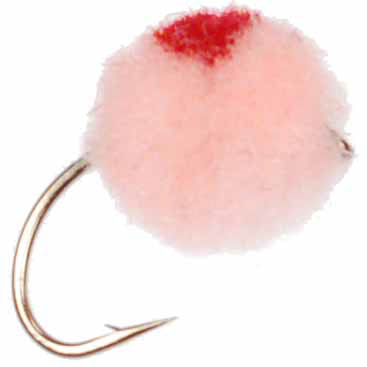
The other main type of egg that is used imitates the larger eggs of the steelhead themselves.  These eggs are held together by a membrane while they mature inside hen steelhead, but that membrane dissolves by the time she is ready to spawn, and generally tend to drift downstream as single eggs.  These eggs may still retain bits of the membrane that originally held them together, they might be transparent, or even pale, milky, and opaque.  These eggs are usually imitated with a glo bug fly.  Made of synthetic materials trimmed into a spherical shape, these flies take on a hazy, translucent appearance when wet, and are often accented by the addition of a synthetic 'egg veil' material to imitate the membrane lining.  Glo bugs with this veiling are generally known as 'nuke eggs', and are a popular variant to the glo bug.  Another highly popular variant is the 'blood dot', which is a glo bug that incorporates a spot of a contrasting color, usually red, in the center of the fly.  This can be considered imitating the yolk of natural eggs, or just giving the fly a little contrast, or that little extra something that will hopefully convince a fish to strike.

While natural steelhead eggs usually are red, orange, or yellow, popular glo bug colors (in addition to these) include white, peach, pink, chartreuse, hot orange, and even blue.  Eggs for Erie steelhead fishing are usually tied on heavy wire, short shanked hooks from size 10 to 18, like the nymphs.  Also, like the nymphs, color and size selection tends to favor larger, brighter, flashier flies in conditions of reduced visibility.

Streamers

As any fly angler knows, streamers generally represent smaller baitfish and are drifted, swung, and stripped to entice gamefish to strike.  In erie, streamers usually follow one of two main classifications: imitative streamers designed to mimic either the ubiquitous emerald shiner or sculpin, or attractor streamers in bright, gaudy colors, incorporating lots of motion.

In the first category, there are any number of emerald shiner patterns available online, and these are actually quite effective drifted as well as a more active, downstream presentation.  They're typically most effective in the lower sections of stream, but a steelhead can be caught on a shiner pattern anywhere in the tribs.  Although they're called emerald shiners, and do have a greenish back, the majority of the body of the minnow is, like most, white and silver, so keep this in mind in your ties.  Sculpins are small bottom feeders that are usually mottled brown or olive in color, and are usually represented by flies such as the muddler minnow.

The second style of streamer are the general attractors that don't look like any fish.  This group includes marabou streamers, 'modern' speys, and the classic woolly bugger.  While almost any fly angler has a few non-bugger streamers in his box, I think you'd be hard pressed to find any steelheader that did not have any buggers.  Their simple design and buggy appearance have earned them a reputation as one of the most widely used flies for anything that swims, from tiny mountain brookies, to huge 40 pound saltwater beasts, and literally everything in between.  Steelhead are no exception, and thousands of steelhead are caught every fall on these flies.

The fly pictured here is called an egg-sucking leech and it is nothing more than a woolly bugger with a bright head made either of chenille or egg material (like you would use to tie a glo bug).  It also incorporates some krystal flash in the tail and it appears to have a little subdued sparkle in the body as well.  All in all, this fly would be very productive on the Erie tribs.

Another woolly bugger variant is the crystal bugger, which uses estaz in place of chenille, giving the fly a bright, flashy, neon body.  Most guys also choose to add an underbody of lead wire, to get some weight incorporated into their flies.

Woolly buggers and other streamers for Erie steelhead are typically tied on long streamer hooks from size 4 down to 12 or 14.  For buggers, the mainstay trout colors of black, white, and olive are also the favorites for steelhead.  Other, more steelhead-specific varieties are purple, pink, orange, and chartreuse, with all of these colors also making great crystal buggers and egg-sucking leech flies.

My Fly Box

Now I'm sure you can read any of hundreds of web sites explaining what flies you should have with you, with their 'secret hot flies' or some strange looking creation...or, more commonly, the typical list that says you should have a dozen sucker spawn in 10 different colors on 10 different sizes of hook, as well as a dozen glo bugs in 20 colors and 5 sizes and...

...who the hell has time for that?  And how many people do you see carrying 2,500 flies around on the water?

The above sizes and colors are meant as suggestions, not a requirement you need to have.  Here's what I like to have with me on the stream.  This inventory is often little more than a dream, as I run out of some flies and tie up a few of a new pattern, or (more likely) forget a batch of flies at home on my tying bench.

Nymphs: I hate fishing nymphs.  A lot.  I just have little confidence in the things, so I rarely fish them, and even when I do, I'm usually quick to switch again.  That said, I usually only tie about two dozen nymphs a year.  When its time for steelhead fishing, I just grab six or eight flies, usually a mix of hare's ear, pheasant tail, and prince nymphs, with a stone or two thrown in, and stick them in with my buggers. Usually, in the spring I still have them all, or all but one or two, and I put them back in with my trout stuff.  Not saying they don't produce fish, I just have little confidence in my own ability to fish with them.

For nymphs, we'll say I carry a pair each of the Hares ear, pheasant tail, prince, and stonefly nymphs, all in a size 14, with a bead head, and lead underbody.

Eggs: I carry an entire box devoted to egg flies.  It's a cheaper Flambeau box with 8 compartments on one side and ripple foam on the other.  I use the compartments for glo bugs and the ripple foam for sucker spawn.  I do this because sucker spawn tend to form a tangled mess in compartments, while glo bugs tend to be fairly easy to separate, and putting them in a compartment keeps them form getting messed up from being smashed together.    For both types of eggs, I make sure I'm well stocked in a few core colors, then tend to experiment with a random selection of others.

For eggs, I carry sucker spawn, all in a #14, trying to keep a dozen each in cream, pink, hot pink, and chartreuse.  I try to have about a half-dozen each in hot orange, pale blue, yellow, and peach as well.  I may carry two or three of other colors, including black, dark blue, purple, mint green, or red just for something different to try.  I may include flashy tails on some of these, or tie them with brightly colored thread, but for the most part, it's just the standard tie.

I also carry glo bugs and estaz eggs on the compartment side, and with my 8 compartments, I usually keep a few different colors in each compartment.  I usually have about twice as many glo bugs as estaz eggs.  For these flies, all are tied on 2X heavy 5X short egg hooks in size 10 (much bigger than most suggest, but that's just my preference).  For the estaz eggs, I carry hot pink, hot orange, chartreuse, blue, and white, about a half dozen of each.  For the glo bugs, I carry a dozen each of pale peach and pale pink, both with red blood dots.  I also carry a dozen big blue glo bugs with and without dots.  Using McFly foam (for a denser, less translucent egg) I try to keep a stock of a dozen each in hot pink, hot orance, and chartreuse.  Other than those key colors, the rest are a hodge-podge of white, yellow, peach, and other random colors, usually only 2 of each.

Streamers: For streamers, I have 3 different types, experimental flies, classic patterns, and buggers.  The first two are just things I'm taking up to try out, so I'm only going to cover buggers.  My selection here is really simple; I carry about a 4 of each in black, white, and olive, in sizes 8 and 10, for a total of 2 dozen buggers.

That's pretty much the core of what I try to have at all times, though, like I said, I often have a piecemeal approximation of that list.  One thing I DO stick to, that I'd suggest you stick to as well is that I always have at least two of every pattern.  The reason is because if you end up finding that a random pattern is the hot fly of the day, you dont want to lose that one fly and be out of luck.

This is about all I can think of to help you go catch your first steelhead.  If you've got any questions at all, feel free to email me at dharmaofthedrift@gmail.com or post a comment on any of these entries, and I'll get back to you as soon as I can.

Good luck in Erie!


Links:

Wednesday, September 29, 2010

Lake Erie Steelhead Fishing Primer (Part 4)

In this installment of the steelhead fishing primer I'll discuss some of the specifics of how to catch fish.  First we'll look at where to fish (that is, where on the section of stream you're fishing...where to fish in general is covered in part 3) and then move on to presentation methods and the best terminal tackle to use in these presentations.

In case you haven't been reading the updates as they were posted, you can find all previous installments at the following links:

Lake Erie Steelhead Fishing Primer (Part 1)
Lake Erie Steelhead Fishing Primer (Part 2)
Lake Erie Steelhead Fishing Primer (Part 3)

Lake Erie Steelhead Fishing Primer (Part 5)

Where to Fish


We've already covered the process of finding a place to fish in part three, but once you get parked, rigged up, and in the water, you're presented with a whole new matter of where to fish, specifically, where within the stream will be the best location to find fish.

Since the steelhead are making their 'run' upstream, in the most literal sense, they can be found anywhere in the stream.  If you have a pool at point A and point B, both holding fish, it only stands to reason that the fish farther upstream had to cross through the "poor holding water" in between the two points to get there.  With this in mind, you can come to one of two conclusions: that the water in between should have fish moving through it (and since all the other fishermen are crowding point A and point B, this is a great place to fish), or that this water in between must not have that many (if any) fish in it, or else they wouldn't have bothered to move up to point B.

Strangely enough, either, both, or neither of these conclusions may be correct.

When steelhead make their run, its generally understood that it isn't one big push from the lake to the upper reaches.  Steelhead will continue to move into the streams from the lake from late August to Thanksgiving, and throughout that time and into the winter, fish already in the stream will continue to migrate in a generally upstream direction, covering a lot of water when conditions allow, and lying low when they don't.  In practice, this run consists of these fish powering upstream through falls, riffles, and rapids, until they get to a deeper, slower section or a pool, where they pause to rest.  While they are in these pools, fish who have nearly regained enough strength to make another push congregate with tired fish just arriving, meaning that the pools of deep, slow water usually have the largest concentrations of fish.  By late October, any given pool can have anywhere from 10 to 100 fish holding in the slow water, catching their breath.  In these situations, there are huge numbers of fish, all in one place, that are easy to spot.  After a moment of thought, the average fisherman usually decides to play the numbers game, and that he has a much better chance of catching one fish out of 100 than one fish out of 2 or 3 in the riffle below the pool.  Unfortunately for the average fisherman, he isn't alone, and he's usually sharing that pool with a minimum of 2-3 other guys and often as many as 8-10.  It's a simple fact of Erie trib fishing that crowds congregate anywhere that large numbers of fish can be easily seen.

The observant fisherman, however, will not that for all those pools holding 30+ fish, and all of those crowds of fishermen hovering over them, there's a disproportionately small portion of those anglers actually seen catching a fish compared to the guys who go off alone and fish an inconspicuous riffle that the others walk past on their way up to that hole up above.  In fact, in terms of catching, as opposed to the amount of fish being cast to, the guys fishing the water that others skip over catch far more than the average guy standing in line beside a pool.

When I'm scouting out new or unfamiliar water for steelhead fishing, I'm looking for three key things: depth, current, and obstacles.  I'm ignoring the pools with stacked fish.  The pools are full of resting fish, and resting fish are not feeding fish.  Any fish caught in a pool is probably biting out of irritation more than any natural reaction to the fly.  So I focus on water just at the heads or tails of pools, where it's fast and flowing.  In terms of depth, I'm looking for water anywhere from 1-3 feet deep.  Much shallower, and the fish will just scoot right by, unable to get comfortable.  Much deeper, and it becomes problematic to get your fly down to the bottom and drift it effectively in the fast current.  Speaking of current, you want it.  Plenty of it, and most of it going in more or less the same direction.  I tend to steer clear of strange back-currents and whirlpools, finding that most of the fish I catch are in more normal flows.  Feel free to try these areas, its just not for me.  Finally, I look for obstacles.  Ideally, you want to find a small section of fast water between pools that has water deep enough for the fish to feel comfortable, in current that's fairly straightforward in terms of getting a drift, with rocks and logs to break up the fast current so that the fish don't feel pressured to keep moving, but rather slow down a bit as they move.

If you can find a spot like this, you'll also find that the fish in this more active water are not nearly as picky as the spooked fish in the pools, and will often take a slightly less than perfect drift.

Presentation Methods


For all of Erie fishing, you really only need to be familiar with 2 methods, the drift and the swing.  Really, these are methods that should be familiar to any fly fisherman, and I'm not going to get into the fundamentals of how to do each here, but rather explain how to use them in the context of Erie steelhead fishing.

For swinging, you'll want to be using a streamer or wet fly.  Anything from about a #16 soft hackle, to a big #2 hairwing will work (also any intruder, tube, etc...from 2-5" long, with maybe a #8 hook).  In the small water of the Pennsylvania Erie tribs don't bother with sinking lines, sink tips, or any other such departures from the norm.  If anything, add some lead 12-24" above your fly on your leader to get the streamer low, or fish it higher in the water column.

Fishing in this way will catch fewer fish because it will only entice the most aggressive, energetic fish in the stream, however, it also tends to mean that the fish you do catch will give you among the most intense fights of any fish in the water.  Swinging streamers also reduces the chances of foul-hooking to nearly zero.

In addition, this method is really simple for the beginner to get the hang of it, but certainly allows for plenty of improvement.  Also, it makes the take exciting and very very obvious, as the fish strikes violently at the fly, hooking itself without any input whatsoever from the angler.  If you've got aggressive fish, this is the way to fish, as you don't have to watch for the very subtle bite as you do while drifting.

Speaking of drifting...

For 90+ percent of Erie steelhead fishermen, the preferred method is the drift.  As I said before, I won't get into the specifics of how to do the drifting, but rather modifications to the technique to tailor the tactic to the Erie steelhead fishery.  For most of the fishing you'll be doing, you will only have a tiny amount of line out.  In fact, for most of the drifting I do, my fly line never touches the water.  You can only really effectively drift about a 20' section of water in front of you, so there's no need to have any kind of advanced nymphing setup, and you will (or most definitely should) have so much lead on your line that the turnover of a leader will be a moot point.

For your setup here, you'll want your fly (or flies...about 3-6" apart...but I don't fish tandem so I can't really dispense advice in that area) drifting along the very bottom of the stream, literally bouncing off the stream bottom.  While some truly fantastically heavy nymph patterns might  be heavy enough to accomplish this alone, for the majority of your fishing, you'll need to add weight to the line.

Weight, Leaders, and Floats

The popular choice here is split shot, but all shot is not created equal.  For Erie, I recommend using three or four (or more) smaller pieces of shot as opposed to one larger piece.  They create less of a disturbance when they hit the water, allow the leader to flex and drift more naturally, and are less likely to get snagged up in rocks and other obstructions.

You definitely want lead shot, too.  The alternatives being tin which is far less dense, meaning you'll need more shot for less weight, and tungsten which is prohibitively expensive, especially in Erie, where you tend to go through terminal tackle pretty quickly.  If you're such a good little environmentalist that you can't bring yourself to use lead shot, Erie fishing probably isn't a natural, pristine enough experience for you anyway.

When you're drifting for steelhead, you must present your fly on the bottom of the stream. I'm talking the bottom 6" of the water column.  If your drift is in the top or middle of the water, you aren't even in the game.

As an added note, while flash on a fly can be a great attracting feature, flash on your shot is anything but.  For steelheading, you'll want dull, drab weight.  If you have some small, dark lead shot that's been sitting in a tackle box for 5 years since you abandoned it for a fly vest, now's the time to get it out.  Tin, in addition to its other shortcomings, is an offender here as well, as it is bright and silvery.  If for whatever reason you must use tin shot, get it early, and let it sit in a cup outside in the elements for a few weeks to dull it.  Better still, hit the shot with a coat of a flat finish spray paint.  Using lead, especially old lead, will solve the problem.

As an alternative, I feel I should mention that I don't use shot, but rather 'matchstick lead'.  As the name suggests, the lead is shaped like a flat compressed-paper match.  To use it, you pull a strip from the book and twist it around your line.  Usually a good, tight twist will be all you need to secure it in place (a quick squeeze form your hemos will fix it if it doesn't want to stay).  Advantages are that the strip is removable and adjustable, and that it doesn't dig into the leader nearly as much as shot.  It's much harder to come by than shot (which can be found anywhere, even wal-mart), but many fly shops will carry it.  I prefer to use "Twist-Ons", which come in the matchbook I described, but I've also used alternatives such as spooled strip lead that, while not quite as convenient, still provided all of the advantages of the matchstick lead and none of the disadvantages of shot, it just wasn't quite as easy to use as the Twist-Ons.


Luckily for you, both methods (drifting and swinging, remember?) are best accomplished with similar leaders. Also luckily for you, the ideal leader is extremely simple: a short, heavy butt section with a slightly finer length of tippet.  No complicated tapers, no step-downs, just heavy leader material tied to your fly line, and 18-30" of tippet tied to the other end.  That's it.

I usually start my day with a fresh 2X or 3X leader (fluoro or mono...your preference), and use it until break offs and fly changes have reduced it to about 5-6 feet in length, and I'm into the thickening part of the taper.  When I get to this point, I tie a perfection loop in the end of the leader, and tighten it properly (moisten the knot, pull it very hard...a 12 pound fish isn't going to baby it, you shouldn't either).  I usually take the added precaution of hitting the knot with a bit of UV Knotsense, but this isn't strictly necessary.  After that, I'll get about two feet of tippet, tie a perfection loop in the end, and loop-to-loop connect it to the end of my leader. This setup will prevent you from slowly consuming your entire leader as you clip it off bit by bit to re-tie tippet.  Since you aren't concerned with a fancy turnover, the somewhat bulky loop-to-loop won't hamper your fishing in the slightest.  In fact, may guys will attach a small swivel to the end of their leader where I put my perfection loop.  This too is a perfectly viable solution.  The only reasons I don't do this are because that would mean I'd also have to carry swivels out on the stream (not a major deal), and that I have a little bit of mistrust when I'm depending on a tiny metal contraption to keep me connected with the fish (major deal).  You might say, "But you trust the hook..."  True, but I never claimed that I always make sense.  Suffice to say that if you like the idea, definitely give it a try.  Hell, I might have just talked myself into giving it a try.

Tippet is one of the few areas I usually get a little spendy.  The mono vs. fluoro debate has been going on for years, so I won't get into that, but what I will say is that for my steelhead fishing I only use Seaguar Grand Max fluorocarbon tippet, in 3X or 4X.  That's it.  Nothing else.  I've had other brands break, wear out quickly, and other undesirable effects, Seaguar has not let me down yet.  Until it does, I'm unlikely to switch.  For trout around home, I like experimenting with different brands (and am currently liking Stroft, Varivas, and Beartooth), but for Erie, I leave the trout tippet at home and bring 2 spools of Seaguar Grand Max.  While it is expensive at $15-16 per spool, for the peace of mind, its worth it, and a spool of each is usually enough to last me the entire season as well as some fishing around home in the spring.  Does that mean you have to buy Seaguar?  Not at all.  In fact, if you can find a cheaper alternative, that's awesome (and I'd appreciate you leaving a comment letting me know what you found!), but for now, for my fishing, I'm going with Seaguar.

Another option that many guys like to use are floats, bobbers, indicators, etc.  Most that use them will say that the indicator helps them "detect the strike" or gives them a "better" drift.  Some might say it "reduces foul-hooking".  While any or all of these reasons might be true, if they are, the indicator is simply a crutch for subpar technique, in my opinion.  If you need help detecting the strike, use an indicator, but really, there's no substitute for being able to detect a strike all on your own.  In high, slow, murky water, a float indicator might get you more fish than you would by not using it, but if you're hitting the fast water, like I suggested, not only will the line not have time to straighten out between fly and indicator, but also, you don't really need it to detect the strike.  If the line stops mid-drift, you either have a fish or a snag, so either way, when the line stops, lift the rod.  As far as a 'better drift' and 'reduced foul-hooking' are concerned, both of these effects result from the switch from a diagonal line drift (like you would have if you were nymph fishing for trout 30-40 feet across the stream), to a more vertical drift (czech nymphing, etc.).  Since this is Erie, you should be within 20 feet of the fish you are casting to, and as such, your drift should already be pretty vertical anyway.

Personally, I almost never use an indicator. They have their time and place, but that time and place, for the most part, isn't found when I'm fishing in Erie.  If you're having trouble detecting a strike in deep pools, try one, but in the faster water, they're fairly unnecessary, in my opinion.  Some people use indicators that don't float, essentially a piece of bright material that they can see underwater, and when it stops or moves against current, they set the hook.  Why not incorporate a hook into that design and essentially fish 2 eggs?

In simplest terms, the more 'junk' you add to your line, the harder it will be to get a flawless drift, so your terminal tackle choices are simply how you choose to balance gear that will help you versus your drift quality. You obviously need a fly.  If you aren't drifting across the bottom, you're not going to catch 95% of the fish, so weight is a necessity.  A float, to me, simply does not offer enough of an advantage to justify its effect on my drift.

Should you decide to use one, there are a dizzying variety of sizes, colors, styles, and attachment methods.  For the few times that I decide to use one, I prefer Thingamabobbers.  They're simple, effective, easy to attach, provide a good compromise of staying where you put them without wrecking your leader, and never wear out.  I got a pair of 3/4" and a 5-pack of 1/2" and I still have all of them, after 2 1/2 years, and they all work just as well as the day I opened the pack.  Of course, I don't use them very often, and in those 2 1/2 years, I've probably spent less than 3% of my time on the water indicator-fishing, but really, their design is simple enough to convince me that they'd get lost from misplacing them sooner than you'd lose one from your line or have one wear out.

For Erie steelhead fishing, stick to the smallest sizes (1/2" and 3/4").  If you get a pack, just choose whatever color you think will best contrast the water in your conditions, if you buy singly, I find I use the orange one most often, but that's just personal preference.  To attach it, just fold your leader into a small loop, push the loop through the hold in the thingamabobber, pass the bobber itself through the loop, and pull it snug.

Well, I had originally intended for this to be the final installment, but there's still fly selection to cover, and I think it deserves its own section, so I'm going to wrap this up.  As always, links to the other sections can be found at the beginning of this article as well as in the following links section, and feel free to leave comments in in the provided comments section.

Links:
Lake Erie Steelhead Fishing Primer (Part 1)
Lake Erie Steelhead Fishing Primer (Part 2)
Lake Erie Steelhead Fishing Primer (Part 3)

Lake Erie Steelhead Fishing Primer (Part 5)

Tuesday, September 21, 2010

Lake Erie Steelhead Fishing Primer (Part 3)

Okay.  You've got your rod, your reel, your line, (that you chose based on the second part of this series) grabbed up a bunch of flies (which flies exactly?  we'll discuss that in the next installment), and you drove up to Erie.  79 drops you onto route 5 and you decided to go east because...well...you felt like it.  Actually you headed east because you missed the exit to go west and now you're going east and that's that.  It's still nice and early (dawn if you timed it right), and you're cruising up through town looking for the giant sign that says: STEELHEAD PARKING AHEAD.  You drive and drive (and drive) and the next thing you know, you're out of the other side of Erie and cruising out over the countryside wondering where the hell these streams are.  Sure, there was that little wet ditch you drove over in town, and you think there might have been a little stream back by that goofy double traffic light with the roads that came in at odd angles (that'd be 4 mile, by the way), but neither of those were steelhead tribs, right?

Wrong.

Steelhead will "run" on any body of moving water that eventually ends up in the lake (and you can tell them I said that).  Elk, Walnut, all the "Mile Creeks"...if you lived on the lake shore and ran a straight pipe from your bathroom to the lake you would probably be taking a shower one day in October and a steelhead would flop up out of the drain at you.  This means that any stream in Erie county could have steelhead in it.  Really.  It's that simple.

Anyway, back to your trip.

You keep driving and its getting lighter and lighter.   You cross several streams, but there's nowhere to park.  Eventually, you see a bridge and a parking lot full of cars beside it and you say, "Here we go!"

Congratulations, you've arrived at 20 mile creek, the third most popular steelhead stream in PA.  Eagerly, you park, string up your rod, and don your waders.  As you get to the top of the bank you see all the people that came in all the cars.  People everywhere.  Both sides of the stream, about 2 drifts apart from one another, as far downstream as the eye can see...and indeed probably the whole way to the lake.  Your heart sinks a bit, but then a guy just below you calls out, "Woah, fish on!" and you watch in amazement as an angry steelhead does battle, thrashing around violently and zipping completely across the stream in a moment.  You note that the people fishing near him have all reeled in their lines and are watching as he fights.  Suddenly, the line goes slack and the rod goes straight.  Your momentary confusion is cleared as the guy comments needlessly, "Fish off."  And everyone goes back to fishing as if nothing ever happened.  You feel bad for the guy, but when his fish ran up toward the bridge, you noticed that nobody was fishing on the upstream side.  You decide to get out and away from the people down here and make your way upstream, to unoccupied waters...

Stop.

There's a reason that conditions on 20 mile are crowded from the bridge to the lake.  Had you not been so excited, you might have wondered why nobody was spreading out.  The reason is that immediately above the bridge, the stream is closed to the public.  Owned by a private club whose name I won't mention, that wants to keep you away from their land and can afford the lawyers to make your life miserable.  Perhaps there was a sign, perhaps there wasn't...its irrelevant.  Its private property, and if you didn't have permission to fish there, you're trespassing.

I'd have to say that, to the beginner, this is one of the more perplexing aspects of steelhead fishing in Erie.  There's public property and private property...open and closed water, access issues, time limitations, and special regulations.  Knowing (or not knowing) what all of this means and how it affect you, the fisherman, can mean the difference between a great day of fishing, and legal issues, fines, or worse.

Before we down to brass tacks, I'm going to provide the links to the other parts of this series.  They're not all linked in any sort of a way that they must be read as a complete package, or even in order, but I do think that each part contains valuable information for any beginner.

Lake Erie Steelhead Fishing Primer (Part 1)
Lake Erie Steelhead Fishing Primer (Part 2)

Lake Erie Steelhead Fishing Primer (Part 4)
Lake Erie Steelhead Fishing Primer (Part 5)

Public Property


This is land (and the water above it), that is owned by some sort of government entity.  Usually, in the case of the Erie tribs, it's owned either by the state (I'm pretty sure the Commonwealth of Pennsylvania owns the Walnut Creek Marina and the project water), or by some local city or municipality (not sure, but I think Elk Creek Access is owned by Lake City).  While the majority of public property is open to fishermen, it's also important to note that there are certain areas that are public property that are closed to fishermen.  For example, Trout Run is one of the most popular areas for catching steelhead, but when you hear someone talking about fishing at Trout Run, they are, in fact, talking about fishing in the lake, at the mouth of Trout Run, not in the stream itself.  The entire length of Trout Run (and Godfrey Run) is designated as nursery water, where the PA Fish & Boat Commission presumably takes the fish that they strip eggs and milt from to make more fish.  As a nursery water, both of these streams are completely closed to fishing.

Aside from Trout and Godfrey runs, I can't think of any other public property completely closed to fishermen.  At the Walnut Marina, you're not permitted to fish from the west bank, across from the marina, but I think that's because it isn't owned by the state.  (For what it's worth, you don't want to fish the marina anyway.)

For the most part, public property tends to be the area most obviously open to fishing.  This is as close as you'll get to seeing a big "Steelhead Fishing Here" sign.  No really.  Most PFBC (PA Fish and Boat Commission) parking areas really do have a sign identifying them as such, usually with a helpful summary of steelhead fishing regulations below.  As a result of being easy to locate, having ample parking, and usually pretty good fishing, public access points are usually some of the most crowded spots in the county.  You can still catch fish and have a good experience, but just understand that you aren't going to have 20 yards of stream to yourself.

Closed Private Property


In addition to the state-owned nursery waters, the other major category of water that you can't fish is water on private property where the land owner does not permit public access to fishing.  This doesn't mean that there will necessarily be a sign.  There might be signs indicating that water is posted, or even a rope or cable across the stream marking closed access, but the land owner is under no obligation to indicate his property is off limits.  Further, this doesn't mean that if you see someone fishing on land that you too are allowed to fish it.  Perhaps these anglers are personal friends or family of the land owner, or have simply asked their permission to fish there.  Just as any other private property, the owner of the land is allowed to choose who is and is not permitted to be on their land.

Some states have 'wet feet' laws, where the banks of streams and rivers are indeed private property, but the streams and rivers themselves are considered a public resource, and as long as you stay within the stream, you are technically on public property.

This is not the case in Pennsylvania.

In this state, the property owner maintains ownership of their plot of land, regardless of whether there is a stream flowing over that land or not.  This means that any time you are wading on private property, your feet are on someone else's land.

Perhaps you're familiar with the legal battle concerning the Little Juniata, and how that water was opened to public fishing based on historical records designating it as a navigable waterway for commercial traffic.  If you're thinking along those lines for Erie, don't.  None of the tribs in Erie, PA are considered commercially navigable, and as such, none are considered public access.  While you're steelhead fishing, the land owner has absolute and final say over who is and is not permitted to fish on their land.

Private Property Open to Public Fishing

This third category covers the remainder of stream access in Erie.  Many, many land owners allow people to fish on their property, and truly some of the best fishing is to be had in these areas.  The trick in this situation is knowing where you're allowed to fish.  Many land owners who allow fishing will helpfully post signs that say "Fishing Permitted: Walk In Only", which means exactly what it says.  They don't want people driving all across their property, so find a pull-off along the road and make your way to the stream on foot.  It's still your responsibility to know where the public access ends, though.  Still, the absence of any sort of sign could mean that the owner does not object to fishermen, but it could also mean that they don't want anglers on their property and don't feel that they should have to post signs to get people to respect this.  While that may be confusing, they're perfectly within their rights to do this.  After all, how would you like it if people regularly walked all through your yard, and when you objected, their response was, "Well, you never put up a sign to say I couldn't!"

The most important thing to remember about private land that allows public access is that it is open through the generosity of the land owner and that it can be withdrawn at any time for any reason.  While it is important all the time, it is especially important on this type of land that you conduct yourself in a mature manner and that you do not litter or otherwise affect the environment in any way.  In fact, picking up some litter and carrying it out of the stream with you would be a thoughtful gesture.

Sometimes a land owner will restrict access to their land, and in these cases, it's usually because of rude anglers littering, or relieving themselves in view of a home.  If someone else if doing these things, there's little you can do about it, but please be sure you aren't that guy.  Just use common sense and treat all land as if it were your own, and don't do anything that you wouldn't appreciate a stranger doing while visiting your property.

In contrast to the public property, any area you hear of without crowds that holds good fishing, or any 'secret spot' (there are no truly secret spots in Erie), most likely is found on private land that allows public access.  Naturally, the more areas that you know about that allow public access, the more areas are open to you to fish, the more likely you are to find a great spot and catch a lot of fish.  But without prior knowledge or years of experience and exploration in Erie, it's hard to get started.  Luckily, this is one area where the internet can help you.

Erie and its tribs are a patchwork quilt of access restrictions, but a quick search can yield a few likely spots.  Particularly, the PFBC has this page:

Lake Erie Stream Descriptions

Which links to a number of pretty in-depth stream descriptions that will give you a great starting point.

As a disclaimer, though, please note that, as I said, a private land owner may decide to close access to their property at any time, for any reason.  Just because an online stream description says a property is open doesn't always mean that it's so.  While you're up in the area, a good way of thinking is simply being observant.  If a number of cars are pulled off near a bridge over a stream, and you can see a dozen or so anglers drifting the water, chances are very good that you can fish there.  It's also good to continue to be observant while fishing.  If everyone seems to be fishing from one bank, perhaps the other bank is closed to the public.  If conditions are crowded below a bridge, perhaps the owner of the land above the bridge doesn't allow access.  Do not assume that because an area is devoid of other anglers that nobody has ever thought to fish there and that your brilliance has allowed you to identify a new secret spot.  If there is nobody fishing in a particular wide area, it usually means one of two things: either you are not allowed to fish there, or there are no fish there to catch.

So now you know what the fishing is like, what gear you need and (after some additional reading at the provided link) where to go.  All that's left is the miry issue of how to catch them.  That's what we'll deal with in the fourth (and final) installment of this beginners' primer to Lake Erie Steelhead Fishing.

Links:


Twitter Delicious Facebook Digg Stumbleupon Favorites More

 
Top Web Hosting | manhattan lasik | websites for accountants