Showing posts with label Steelhead. Show all posts

Thursday, December 22, 2011

My Fall (Part 2)

Aside from my now job, there were a few other really notable positives in the fall, the most relevant one to my readers is that I caught my largest trout to this point.


I didn't have a tape at the time, but comparing it to the rod beside it, I estimate it to be a 22-24" tiger trout.  This is my third tiger, and it was an intense fight on my 4wt!

As usual, I took a break from the small streams and wild brookies when they decided it was time to spawn...


As I said, I made it to Erie to do some steelhead fishing...


And for the first time in my life, I went duck hunting.  A friend of mine invited me to do a few days of hunting with him, and now I'm hooked, and on a mission to get a few ducks around here on my own.  My first duck hunting trip was successful...


But subsequent trips have been a bit less so.  In any event, it's a new venture for me, and just like fly fishing, I don't expect lots of early success.  I'll be out again early tomorrow morning to try to get a few, but even if I don't get any, every trip out is one closer to the trip where it all finally clicks.  For now, I'm just enjoying learning something new.

A few weeks after my first duck hunting outing, I started my new job, and focused on adjusting to it for a few weeks after that.  Still, it couldn't have come at a better time, as it meant I could afford the gas and hotel room to make the drive up to Somerset, NJ for the 2011 International Fly Tying Symposium.  While I was there, I made sure to take plenty of photos...

...which you will all get to see in my next update!

That's all for now.  Merry Christmas to all my readers, and when I post again after the holiday, you'll have lots of fly pictures!

Wednesday, December 21, 2011

It's Been One Heck of a Fall

Hello again to all of my readers.

No, I'm not gone for good, but I had a lot of changes in my life over the past few months, and while I wasn't busy the entire time, usually when I had the time to post, I just wasn't inspired to do so.  While I'm not exactly inspired now, I wanted to pop in to let everyone know what's up.  My readers have been great ever since I got Dharma of the Drift started, so I wanted to let you know where I've been as well as where I intend to be in the future, with regard to the blog here.

When I last posted, it was early September.  summer fishing was winding to a close and my thoughts were rapidly turning north with thoughts of Lake Erie steelhead.  Then the unexpected happened, and I lost my job.

In retrospect, getting laid off hit me much harder than I ever thought it might.  Sure, there's the financial hardship, and the daunting task of finding a new job in this economy, but the hardest thing for me was the blow to my self-confidence.  It wasn't that I'd failed to perform or done anything wrong at work...just that, even after holding my position for four years, I was still low man on the totem pole in my department.  Business had been slow for a long time, everyone knew this, and my employers had done what they could to avoid layoffs, but as time went on and prospects remained bleak, they were forced to make difficult decisions, and while I wasn't pleased with the outcome, I don't take it personally.

Like I said, the biggest impact, for me, was the blow to my confidence.  While a part of me knew it had nothing to do with me as a person or a worker, it's hard to avoid the nagging feeling that somehow you didn't measure up or you weren't good enough.  I'm sure anyone who's been laid off before can understand.

While I immediately got to work getting my resumee into shape, I wasn't really optimistic about hunting for a job, interviewing, or even doing the things I enjoyed, like fishing, tying, and taking pictures.  My family was really great at that time, keeping me moving and encouraging me, while at the same time giving me the space I needed to sort things out on my own.

Over the next several weeks, I got my resumee up to date and submitted it to at least a dozen places, in person, online, you name it.  Eventually, keeping myself busy with the job hunt got me thinking about fishing again, and I realized, finally, that without a job, I was uniquely available for making a trip or two to Erie to fish during the less crowded weekdays in the early season.  This also got me back to tying, and before long I had dozens of eggs and buggers in boxes, and was driving north on I-79.  Through late September and early October, I managed to spend 7-8 days steelhead fishing, having some of my best days since starting to fish for steelhead.  Through this same time, I started to get a few calls about my resumees.  Finally, in early October, I got my first interview.

Things went well and through a bit of fate or karma or divine providence, the job I applied for (which wasn't in my field) was already filled, buuuuuuut they were considering adding a position that was exactly in my field.  At this point, a lot of my optimism and confidence returned, even though I still didn't have a job.  I think it was just the idea that yes, my skills were still useful, and yes, I had a chance at what seemed like a nice job.  I think my confidence must have shown through a bit, and they said they'd be in touch to schedule another interview.

Turns out that they called while I was up in Erie, fishing for steelhead.  After my trip, I returned, and did another interview, and a few days later, I got the call: I'd gotten the job.

I started my new job on Halloween, and while I do understand that I was fortunate, and very much in the right place at the right time, it gives me a little hope for our ailing economy.  I don't wish to use the site here as some sort of soapbox for my political views, but suffice to say that while there are certainly people that are in the position I was in for two months that abuse the system and don't try, I like to believe that there are lots more good, honest people that are trying, and that their right place and right time just haven't come yet.

In any event, that covers my life in September and October. I'm getting tired, and I have a cold, so I'm going to stop here for now, and finish bringing everyone up to speed in another post.  That'll likely be tomorrow.

Hopefully, my return finds my readers in good health and high spirits!

Tuesday, September 6, 2011

Introducing: Iso Hatch Exposures

No big, meaty blog post today, just a question and an announcement for my readers.

First the question:

About a year ago, I wrote the five part Erie steelhead guide that has become, easily, the most viewed, linked to, talked about, and shared pages that I've ever produced.  It's clear that this is something that people really enjoyed, whether you (the readers) were the novice steelheaders that the articles were aimed toward, experienced steelhead anglers that were nonetheless interested, or even folks with no interest or inclination to go steelhead fishing that simply wanted to see what it was all about.

This year, I got started in my steelhead season preparation a bit later, having a trip to upstate New York to prepare for (and go on, naturally) at the beginning of August.  From the day I got back, however, to the present, it's been Operation: Steelhead at my vise.

That said, I'd like to write another piece on some aspect of the Erie steelhead experience, and I'm hoping my readers will let me know what they want.

I've been leaning toward a multi-piece article focusing on the tying aspect of things, covering everything from hooks and materials to tutorials and applications for all of the popular steelhead flies, from eggs and nymphs to buggers, hairwings, and specialty flies such as modern spey and intruders.

If this is something that my readers would be interested in, the comments section is the place to let me know.  If you have a different idea, that's the place to sound off as well.

Second, the announcement:

Over the weekend, I took advantage of some free time to finally launch a second Blogger site, focusing on my photography.  Over the past two or three years, photography, for me, has grown from taking a few pictures a month with a ten year old basic Kodak digital, to a hobby that occupies nearly as much of my time and energies as my fly fishing and tying.  While you've seen a significant portion of that work here, there's plenty of other pictures that never make it to the blog, simply because there's no reason for these photos to show up in a blog about fly fishing and tying.  Additionally, I tend to feel bad, like I've somehow 'cheaped out' if I post pictures with little or no text.  This sometimes keeps me from posting when I otherwise might.

I wanted to share these photos and avoid that stigma by starting a dedicated photoblog where I could post photos of anything and everything, without much text at all to distract from the images.

This desire helped bring about my new photoblog, and although it's in its very early stages and still undergoing many tweaks and adjustments, I'm eager to share it with my readers here.

Please take a look at it and let me know what you think, as well as any suggestions either here OR there...

Saturday, December 25, 2010

Baby Sparkle Sculpin Fly Tying Tutorial

Baby Sparkle Sculpin


Recipe
Hook: Mustad 36890, Size 10
Thread: 8/0, Black
Wing: Pine Squirrel Zonker Strip, Natural
Body: Dubbing (any bright, flashy dubbing, SLF Prism in Olive shown)
Collar: Pine Squirrel Zonker Strip, Natural (same strip used in wing)

Instructions


As always, begin by placing the hook in the vise.  I prefer the looped, up-eye salmon hooks for all my streamers, but, as usual, any long shank streamer hook will work.  This pattern is also limited in its size by the natural length of the squirrel fur, meaning that it will begin to lose proportion in sizes much bigger than #8, and the hide itself will make it too bulky to be practical much smaller than #12.


Wrap an underbody of .025 lead, proportioned as shown.  With the loop eye hooks, I tend to use the end of the wire as my transition point, wrapping the lead up to it, and using it as a sort of fixed 'landmark' for other proportioning purposes on a variety of ties, but you can tie it just fine on a ring-eye, just be sure to leave space for the collar.


Tie in the pine squirrel zonker at the back of the lead underbody, extending just past the back of the bend, but not long enough to foul, with the natural grain of the hair sweeping back.  Be sure to separate the hair at the tie in point so that you don't bind any of it down.  This will no only make for a neater appearance and maximum movement in the water, but binding down the hair will make the tie in point much weaker.


After making about 3 wraps binding the strip down, pull the front end back and make 2-3 more wraps tight against the tie in point to lock it in, then tie in a thread loop about 6" long, and advance your thread to the front of your lead underbody.  Then get your dubbing loop tool into the loop you created.


Wax the loop if you like, then fill it with your dubbing of choice.  Literally any dubbing will work here, though, in the interests of keeping it a "Sparkle Sculpin", bright, flashy dubbings are given the nod at my tying bench.  In this case, I'm using SLF Prism dubbing in Olive.


Twist up your dubbing loop.  For a loop this big, twist it up a lot.  You won't ahve to worry about twisting it too tightly, and twisting too loose might allow some of the dubbing to get pulled out by fish.


Wind the dubbing loop onto the lead underbody.  On a size 10 hook, that 6" loop will allow you to wrap it on pretty tightly, so try not to leave any bare spots.  Tie it off and trim any excess at the front of the lead underbody.  If you like, tease out the dubbed body with a toothbrush.


Pull the zonker strip forward, over the body.  There should be a little tension in the strip to keep it upright, but not so much tension that its going to pull itself out of place.  Tie the strip down at the front of the dubbed body, again taking care not to bind down the fur.  Also like last time, pull the strip back, and make a few locking wraps immediately in front of the tie in point.


Pull the strip to the side and make one wrap around the hook shank, making sure it lays with the hide side against the hook, with the hair standing out much like hackle.  After that one wrap, tie off and trim.  Leave room for the head, but if your tie off point is almost to the eye, don't worry about it, just snip it as close as you possibly can, to make for a smaller, neater head.


The finished fly.


A stringer of sculpins, tied with a variety of dubbings and colors.  From left to right: pink and red antron, olive, orange, and caddis green SLF Prism, blue ice dub, purple polar dub, and blue laser dub.

This is an evolution of a pattern that worked well for me over the 2010 season on both trout and steelhead as well as  warmwater bass who may have taken it for a small tadpole.  The old pattern used a body first of tinsel, then mylar braid (used on crystal meth)...this dubbed body version adds a lot of ability to customize the look for different tastes and conditions.  It may be my reason to try out some shaggy dub next spring.

Fish this pattern like any streamer pattern, drift, swing, strip as needed.  The fairly heavy gauge lead on such a small hook makes it ideal for probing those hard to reach areas like deep pools, exposed root balls, and undercuts, that the larger trout in a small stream usually claim as their own (and aggressively defend), and the small size makes it manageable for even a 3wt rod to throw at the distances usually necessary for small stream angling.  Toss upstream allowing it to tumble across the bottom into the lie, then after giving it a little time to sink, but not enough time to drift out of the lie, swing or strip it away quickly.  Usually for me, the strike will come just a few moments after the swing begins.

Saturday, December 11, 2010

This Fly Needs A Name

I'm finally getting around to using some of the beautiful feathers I brought home from the Symposium, and this is one that I'm very pleased with.  Figured I'd share it with you guys tonight:


Tied on a 1/0 Dai-riki #899, purple seal in front of the floss, and a wing of hackle dyed 'grizzly mot mot crown' from John McLain of FeathersMc.

Monday, November 15, 2010

Drifting Flies for Erie Steelhead

With the steelhead primer being so well received by the online community, I've been getting some feedback here and there, with comments, suggestions, and, in some cases, some questions.  Whether a reader is seeking clarification on something I wrote in one of the parts of the primer, or they're seeking new information on an area I covered briefly, or not at all, I do my best to get back to them with an answer as soon as I can.  In most cases, that means within 2-3 weekdays, but in one case was as soon as a few hours.

That said, I encourage anyone reading DotD who feels so inclined to send along an email.  In addition to using the 'Contact Me' button in the sidebar, you can also send an email direct to dharmaofthedrift@gmail.com and I'll get a response to you as soon as I can.

Just recently, Dharma of the Drift reader Bob sent in the following question via email:

Just finished reading your 5 section steelhead report, and found it interesting that I seem to be doing things pretty much the way you suggest (with a few exceptions).  Now I am more prepared to feel confident about my tactics.  Thank you for sharing this info.  I guess my biggest question is how to get the "perfect drift".  Besides what you mentioned do you have any other tips regarding a good drift. I try to cast it out, mend right away, high stick and then bow down.  Does this sound right?  


I appreciate any advice. 

Bob

First of all, I'd like to thank Bob here on the site for reading DotD and for sending his email.  Interaction with readers helps me keep the content here relevant and helpful, which, in turn, keeps you coming back for more!

After sending along what I could offer on the subject, I also mentioned that I'd like to share with the rest of the reader base and Bob agreed that the information might help out some other readers.

Here's what I had to offer Bob:


Hi Bob,
Thanks for reading, and for the email as well!
The 'perfect drift' is really the one central thing that stratifies Erie steelhead anglers.  While ten anglers on a given stretch of water may all have the same rod, reel, line, leader, and fly, the thing that will separate them is their proficiency with the drift (and detecting the strike).  I won't claim to be any kind of an expert, as I prefer to fish dries and streamers for trout (meaning that I get very little practice at a subsurface drift), but this is what I can say:
There's a lot of variance in opinion as to what the perfect drift even looks like.  Conventional wisdom tells us that it'd be a drift where the fly behaves just like a natural egg, tumbling in the current, at the same speed as the water, but many guys feel that a drift that is actually 2-3 times slower than the current is best.  
Keep in mind that the 'perfect' drift is the one that gets a bite, so when I talk about a better drift it's one that's more likely to fool a fish, not necessarily the one with absolutely no drag.  With this in mind, getting a good drift becomes more and more difficult the deeper the water being fished.  You nearly always want to bounce your fly along the bottom, and deeper water means that there's just that much more current and drag to deal with.  Slow water also makes a good drift more difficult, as the fish get more time to inspect the offering, and you have to make flawless mends and keep the drift going for a longer period of time.  This, combined with resting, spooky fish, is why its much more time-effective to pass up the deep, slow pools and head for the fast, shallow riffles.
Fast water means you need the fly to drop quicker, but you can do this.  The faster water will hide your mend and will also allow you to place weight much closer to the fly than you could get away with in the slow pools.  In really fast water, I'll sometimes use a #8 or #10 glo bug (you can also use bigger flies in fast water), with lead at 6-12" and again at 12-18" from the fly.  Having lead 6" from your fly might seem like a mistake, but it will help get your fly down in the strike zone quickly, and in truly turbid water, it will help to keep your fly and your lead in the same currents.  Also in this water, having lead that close won't really spook the fish.
From your description, it sounds like you have a pretty intuitive understanding of how to drift.  When I do it, I basically try to walk the fine line of having no tension in the line but also no slack.  Any tension means that your line is preventing a drag-free drift (proponents of the 2-3x slower than the current method will have tension in their line), and any slack will make detecting a strike nearly impossible without extremely perceptive vision or a very obvious take (unlikely with Erie steel).
I hope this helped address your question, and maybe even will help you catch more fish.
Thanks,
Mark

So there you have it.  As I said in my email to Bob, I'm by no means an expert, and simply do what I can and what seems to work.  If anyone has any other questions or suggested additions to the primer, feel free to email or comment on any of the steelhead articles, and if I can help you out, I'll try.

Tuesday, October 5, 2010

Lake Erie Steelhead Fishing Primer (Part 5)

So here we are, at the last portion of the Erie Steelhead series.  So far we've separated fact from myth in Erie, learned about the proper gear you should outfit yourself with for trib fishing, how to determine the areas of the tribs where fishing is permitted, and finally tactics for catching fish as well as setups for using those tactics.  In this final installment, we'll talk about the flies that you should have in your box when you hit PEnnsylvania's Erie watershed in search of steelhead.


In case you haven't been reading the updates as they were posted, you can find all previous installments at the following links:


Essential Erie Steelhead Flies

If you were to take a random selection of 100 Erie fly anglers and look at the flies they carried with them on the streams, you'd find a truly incredible array of patterns, colors, sizes, shapes, and materials.  You'd find extremes ranging from five inch long sculpin patterns to tiny midges, and everything in between.  Still, if you took them all together, you'd find a few strong trends, things that nearly every angler carried, and for good reason.

The first thing you might notice would be that, compared to the average trout angler, the steelheader tends to carry a relatively large proportion of bright, flashy, neon, glow-in-the-dark, and fluorescent colored flies.  Sure, most guys also have drab, natural nymphs too, but while a trout fly box might have a half-dozen hot pink or chartreuse flies, the Erie steelheader's fly box will be dominated with bright, gaudy, overstated colors.  Likewise, while almost any angler appreciates some sparkle and flash, only a steelheader will try to incorporate it on almost every pattern.  Indeed, there are steelhead flies made entirely of krystal flash.

While color and flash certainly set a steelhead fly box apart from a trout box, color and flash are, usually, just a variant of a specific type of fly.  For example, while you might use a stonefly nymph for trout, give it a hot pink thorax and a krystal flash tail and it's a steelhead stone.  Looking at flies based solely on pattern and you will see an overwhelming majority of Erie steelheaders carrying boxes comprised almost entirely of three types: nymphs, eggs, and streamers...especially the venerable woolly bugger.  It is upon these three main types that this article will focus.

Nymphs

There isn't much as far as nymph flies that the average trout angler needs to be taught to choose effective flies for Erie steelhead.  Generally, stick to your classic patterns like the Hare's Ear, Pheasant Tail, Prince Nymph, and your favorite stonefly nymph.  While the standard tie is effective, if you wish to tailor them to the Erie tribs and steelhead fishing, you can make several modifications.

The first modification you can make to your nymph ties is to add weight.  Extra wraps of lead wire in the underbody, heavier lead wire, bead heads, double bead heads, tungsten, you name it.  The more lead you tie into the fly the better.  In fast water, that will mean less lead on the line, and in slow water, you may not need any lead at all.  You can also help to add weight in your choice of hook.  You'll definitely want to go with 2X heavy nymph hooks, and should also consider 1 or 2X long as well, which will allow you to add your bead head plus lead wraps on your thorax, without crowding the proportions of the fly.  

The second typical method of tying nymphs for steelhead is to add brightness, whether in the form of flash or bright colors.  Consider replacing the typical tail with some krystal flash, use a piece of mirage tinsel for your wing case, replace any sort of wing with more flash.  Also, you may accent the typical tie with bright colors such as fluorescent wire ribbing, or a bright pink, orange, or blue 'hot spot' on the thorax.  Check out this stonefly modified for steelhead:
Typically, nymphs for Erie steelhead fishing in the Pennsylvania tribs are tied on heavy nymph hooks from size 10 all the way down to 18.  Conventional wisdom suggests using bigger flies and brighter, flashier colors for murky water, and smaller, more natural colored nymphs in low and clear conditions.

Eggs

Some anglers regard eggs as a 'lesser fly' that no true angler would stoop to using, but the fact is that steelhead take these flies.  Often.  And anyone who looks down on you for using egg flies on the PA tribs is a snob, plain and simple.  Ignore them, and proceed to catch a few fish on egg flies.

Typically in Erie, eggs are tied to imitate, vaguely, one of two types of eggs: those of the steelhead themselves, or those of the suckers that are also abundant in the Erie tribs.  For the sucker's part, their eggs are tiny and tend to stick to one another and form tiny clump in the water, surrounded by a milky haze.  Rather than try to imitate this exactly by tying a fly with a bunch of tiny eggs in it, most people tend to imitate these eggs in general by imitating the translucent, lumpy mass and the milky haze.  

Possibly the best known fly for this is the aptly named sucker spawn, which uses angora yarn, tied in loops, to simply and effectively imitate an egg mass.


In this picture, the fly also incorporates a flash tail and a brightly colored body, making it ideal for steelhead.

In addition to the natural, typical colors for these flies (white, cream, pale pink, peach, and yellow), neon colors like hot pink, fluorescent orange, and chartreuse are also highly effective, especially in murky water.  Also, in addition to the angora yarn traditionally used, people use a variety of materials to tie this style of egg including glo bug yarn (to tie the fly called scrambed eggs) and mylar braid (to tie crystal meth).  This is also a fly that lends itself well to experimentation with other materials, and I've found a few yarns at the craft store that make excellent egg flies.  Look for light, wispy materials.

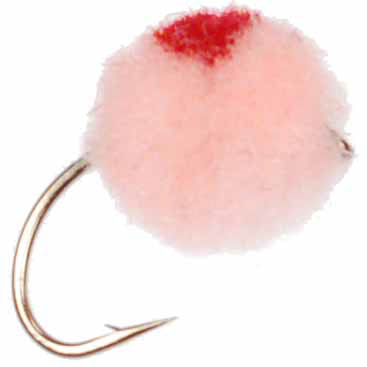
The other main type of egg that is used imitates the larger eggs of the steelhead themselves.  These eggs are held together by a membrane while they mature inside hen steelhead, but that membrane dissolves by the time she is ready to spawn, and generally tend to drift downstream as single eggs.  These eggs may still retain bits of the membrane that originally held them together, they might be transparent, or even pale, milky, and opaque.  These eggs are usually imitated with a glo bug fly.  Made of synthetic materials trimmed into a spherical shape, these flies take on a hazy, translucent appearance when wet, and are often accented by the addition of a synthetic 'egg veil' material to imitate the membrane lining.  Glo bugs with this veiling are generally known as 'nuke eggs', and are a popular variant to the glo bug.  Another highly popular variant is the 'blood dot', which is a glo bug that incorporates a spot of a contrasting color, usually red, in the center of the fly.  This can be considered imitating the yolk of natural eggs, or just giving the fly a little contrast, or that little extra something that will hopefully convince a fish to strike.

While natural steelhead eggs usually are red, orange, or yellow, popular glo bug colors (in addition to these) include white, peach, pink, chartreuse, hot orange, and even blue.  Eggs for Erie steelhead fishing are usually tied on heavy wire, short shanked hooks from size 10 to 18, like the nymphs.  Also, like the nymphs, color and size selection tends to favor larger, brighter, flashier flies in conditions of reduced visibility.

Streamers

As any fly angler knows, streamers generally represent smaller baitfish and are drifted, swung, and stripped to entice gamefish to strike.  In erie, streamers usually follow one of two main classifications: imitative streamers designed to mimic either the ubiquitous emerald shiner or sculpin, or attractor streamers in bright, gaudy colors, incorporating lots of motion.

In the first category, there are any number of emerald shiner patterns available online, and these are actually quite effective drifted as well as a more active, downstream presentation.  They're typically most effective in the lower sections of stream, but a steelhead can be caught on a shiner pattern anywhere in the tribs.  Although they're called emerald shiners, and do have a greenish back, the majority of the body of the minnow is, like most, white and silver, so keep this in mind in your ties.  Sculpins are small bottom feeders that are usually mottled brown or olive in color, and are usually represented by flies such as the muddler minnow.

The second style of streamer are the general attractors that don't look like any fish.  This group includes marabou streamers, 'modern' speys, and the classic woolly bugger.  While almost any fly angler has a few non-bugger streamers in his box, I think you'd be hard pressed to find any steelheader that did not have any buggers.  Their simple design and buggy appearance have earned them a reputation as one of the most widely used flies for anything that swims, from tiny mountain brookies, to huge 40 pound saltwater beasts, and literally everything in between.  Steelhead are no exception, and thousands of steelhead are caught every fall on these flies.

The fly pictured here is called an egg-sucking leech and it is nothing more than a woolly bugger with a bright head made either of chenille or egg material (like you would use to tie a glo bug).  It also incorporates some krystal flash in the tail and it appears to have a little subdued sparkle in the body as well.  All in all, this fly would be very productive on the Erie tribs.

Another woolly bugger variant is the crystal bugger, which uses estaz in place of chenille, giving the fly a bright, flashy, neon body.  Most guys also choose to add an underbody of lead wire, to get some weight incorporated into their flies.

Woolly buggers and other streamers for Erie steelhead are typically tied on long streamer hooks from size 4 down to 12 or 14.  For buggers, the mainstay trout colors of black, white, and olive are also the favorites for steelhead.  Other, more steelhead-specific varieties are purple, pink, orange, and chartreuse, with all of these colors also making great crystal buggers and egg-sucking leech flies.

My Fly Box

Now I'm sure you can read any of hundreds of web sites explaining what flies you should have with you, with their 'secret hot flies' or some strange looking creation...or, more commonly, the typical list that says you should have a dozen sucker spawn in 10 different colors on 10 different sizes of hook, as well as a dozen glo bugs in 20 colors and 5 sizes and...

...who the hell has time for that?  And how many people do you see carrying 2,500 flies around on the water?

The above sizes and colors are meant as suggestions, not a requirement you need to have.  Here's what I like to have with me on the stream.  This inventory is often little more than a dream, as I run out of some flies and tie up a few of a new pattern, or (more likely) forget a batch of flies at home on my tying bench.

Nymphs: I hate fishing nymphs.  A lot.  I just have little confidence in the things, so I rarely fish them, and even when I do, I'm usually quick to switch again.  That said, I usually only tie about two dozen nymphs a year.  When its time for steelhead fishing, I just grab six or eight flies, usually a mix of hare's ear, pheasant tail, and prince nymphs, with a stone or two thrown in, and stick them in with my buggers. Usually, in the spring I still have them all, or all but one or two, and I put them back in with my trout stuff.  Not saying they don't produce fish, I just have little confidence in my own ability to fish with them.

For nymphs, we'll say I carry a pair each of the Hares ear, pheasant tail, prince, and stonefly nymphs, all in a size 14, with a bead head, and lead underbody.

Eggs: I carry an entire box devoted to egg flies.  It's a cheaper Flambeau box with 8 compartments on one side and ripple foam on the other.  I use the compartments for glo bugs and the ripple foam for sucker spawn.  I do this because sucker spawn tend to form a tangled mess in compartments, while glo bugs tend to be fairly easy to separate, and putting them in a compartment keeps them form getting messed up from being smashed together.    For both types of eggs, I make sure I'm well stocked in a few core colors, then tend to experiment with a random selection of others.

For eggs, I carry sucker spawn, all in a #14, trying to keep a dozen each in cream, pink, hot pink, and chartreuse.  I try to have about a half-dozen each in hot orange, pale blue, yellow, and peach as well.  I may carry two or three of other colors, including black, dark blue, purple, mint green, or red just for something different to try.  I may include flashy tails on some of these, or tie them with brightly colored thread, but for the most part, it's just the standard tie.

I also carry glo bugs and estaz eggs on the compartment side, and with my 8 compartments, I usually keep a few different colors in each compartment.  I usually have about twice as many glo bugs as estaz eggs.  For these flies, all are tied on 2X heavy 5X short egg hooks in size 10 (much bigger than most suggest, but that's just my preference).  For the estaz eggs, I carry hot pink, hot orange, chartreuse, blue, and white, about a half dozen of each.  For the glo bugs, I carry a dozen each of pale peach and pale pink, both with red blood dots.  I also carry a dozen big blue glo bugs with and without dots.  Using McFly foam (for a denser, less translucent egg) I try to keep a stock of a dozen each in hot pink, hot orance, and chartreuse.  Other than those key colors, the rest are a hodge-podge of white, yellow, peach, and other random colors, usually only 2 of each.

Streamers: For streamers, I have 3 different types, experimental flies, classic patterns, and buggers.  The first two are just things I'm taking up to try out, so I'm only going to cover buggers.  My selection here is really simple; I carry about a 4 of each in black, white, and olive, in sizes 8 and 10, for a total of 2 dozen buggers.

That's pretty much the core of what I try to have at all times, though, like I said, I often have a piecemeal approximation of that list.  One thing I DO stick to, that I'd suggest you stick to as well is that I always have at least two of every pattern.  The reason is because if you end up finding that a random pattern is the hot fly of the day, you dont want to lose that one fly and be out of luck.

This is about all I can think of to help you go catch your first steelhead.  If you've got any questions at all, feel free to email me at dharmaofthedrift@gmail.com or post a comment on any of these entries, and I'll get back to you as soon as I can.

Good luck in Erie!


Links:

Wednesday, September 29, 2010

Lake Erie Steelhead Fishing Primer (Part 4)

In this installment of the steelhead fishing primer I'll discuss some of the specifics of how to catch fish.  First we'll look at where to fish (that is, where on the section of stream you're fishing...where to fish in general is covered in part 3) and then move on to presentation methods and the best terminal tackle to use in these presentations.

In case you haven't been reading the updates as they were posted, you can find all previous installments at the following links:

Lake Erie Steelhead Fishing Primer (Part 1)
Lake Erie Steelhead Fishing Primer (Part 2)
Lake Erie Steelhead Fishing Primer (Part 3)

Lake Erie Steelhead Fishing Primer (Part 5)

Where to Fish


We've already covered the process of finding a place to fish in part three, but once you get parked, rigged up, and in the water, you're presented with a whole new matter of where to fish, specifically, where within the stream will be the best location to find fish.

Since the steelhead are making their 'run' upstream, in the most literal sense, they can be found anywhere in the stream.  If you have a pool at point A and point B, both holding fish, it only stands to reason that the fish farther upstream had to cross through the "poor holding water" in between the two points to get there.  With this in mind, you can come to one of two conclusions: that the water in between should have fish moving through it (and since all the other fishermen are crowding point A and point B, this is a great place to fish), or that this water in between must not have that many (if any) fish in it, or else they wouldn't have bothered to move up to point B.

Strangely enough, either, both, or neither of these conclusions may be correct.

When steelhead make their run, its generally understood that it isn't one big push from the lake to the upper reaches.  Steelhead will continue to move into the streams from the lake from late August to Thanksgiving, and throughout that time and into the winter, fish already in the stream will continue to migrate in a generally upstream direction, covering a lot of water when conditions allow, and lying low when they don't.  In practice, this run consists of these fish powering upstream through falls, riffles, and rapids, until they get to a deeper, slower section or a pool, where they pause to rest.  While they are in these pools, fish who have nearly regained enough strength to make another push congregate with tired fish just arriving, meaning that the pools of deep, slow water usually have the largest concentrations of fish.  By late October, any given pool can have anywhere from 10 to 100 fish holding in the slow water, catching their breath.  In these situations, there are huge numbers of fish, all in one place, that are easy to spot.  After a moment of thought, the average fisherman usually decides to play the numbers game, and that he has a much better chance of catching one fish out of 100 than one fish out of 2 or 3 in the riffle below the pool.  Unfortunately for the average fisherman, he isn't alone, and he's usually sharing that pool with a minimum of 2-3 other guys and often as many as 8-10.  It's a simple fact of Erie trib fishing that crowds congregate anywhere that large numbers of fish can be easily seen.

The observant fisherman, however, will not that for all those pools holding 30+ fish, and all of those crowds of fishermen hovering over them, there's a disproportionately small portion of those anglers actually seen catching a fish compared to the guys who go off alone and fish an inconspicuous riffle that the others walk past on their way up to that hole up above.  In fact, in terms of catching, as opposed to the amount of fish being cast to, the guys fishing the water that others skip over catch far more than the average guy standing in line beside a pool.

When I'm scouting out new or unfamiliar water for steelhead fishing, I'm looking for three key things: depth, current, and obstacles.  I'm ignoring the pools with stacked fish.  The pools are full of resting fish, and resting fish are not feeding fish.  Any fish caught in a pool is probably biting out of irritation more than any natural reaction to the fly.  So I focus on water just at the heads or tails of pools, where it's fast and flowing.  In terms of depth, I'm looking for water anywhere from 1-3 feet deep.  Much shallower, and the fish will just scoot right by, unable to get comfortable.  Much deeper, and it becomes problematic to get your fly down to the bottom and drift it effectively in the fast current.  Speaking of current, you want it.  Plenty of it, and most of it going in more or less the same direction.  I tend to steer clear of strange back-currents and whirlpools, finding that most of the fish I catch are in more normal flows.  Feel free to try these areas, its just not for me.  Finally, I look for obstacles.  Ideally, you want to find a small section of fast water between pools that has water deep enough for the fish to feel comfortable, in current that's fairly straightforward in terms of getting a drift, with rocks and logs to break up the fast current so that the fish don't feel pressured to keep moving, but rather slow down a bit as they move.

If you can find a spot like this, you'll also find that the fish in this more active water are not nearly as picky as the spooked fish in the pools, and will often take a slightly less than perfect drift.

Presentation Methods


For all of Erie fishing, you really only need to be familiar with 2 methods, the drift and the swing.  Really, these are methods that should be familiar to any fly fisherman, and I'm not going to get into the fundamentals of how to do each here, but rather explain how to use them in the context of Erie steelhead fishing.

For swinging, you'll want to be using a streamer or wet fly.  Anything from about a #16 soft hackle, to a big #2 hairwing will work (also any intruder, tube, etc...from 2-5" long, with maybe a #8 hook).  In the small water of the Pennsylvania Erie tribs don't bother with sinking lines, sink tips, or any other such departures from the norm.  If anything, add some lead 12-24" above your fly on your leader to get the streamer low, or fish it higher in the water column.

Fishing in this way will catch fewer fish because it will only entice the most aggressive, energetic fish in the stream, however, it also tends to mean that the fish you do catch will give you among the most intense fights of any fish in the water.  Swinging streamers also reduces the chances of foul-hooking to nearly zero.

In addition, this method is really simple for the beginner to get the hang of it, but certainly allows for plenty of improvement.  Also, it makes the take exciting and very very obvious, as the fish strikes violently at the fly, hooking itself without any input whatsoever from the angler.  If you've got aggressive fish, this is the way to fish, as you don't have to watch for the very subtle bite as you do while drifting.

Speaking of drifting...

For 90+ percent of Erie steelhead fishermen, the preferred method is the drift.  As I said before, I won't get into the specifics of how to do the drifting, but rather modifications to the technique to tailor the tactic to the Erie steelhead fishery.  For most of the fishing you'll be doing, you will only have a tiny amount of line out.  In fact, for most of the drifting I do, my fly line never touches the water.  You can only really effectively drift about a 20' section of water in front of you, so there's no need to have any kind of advanced nymphing setup, and you will (or most definitely should) have so much lead on your line that the turnover of a leader will be a moot point.

For your setup here, you'll want your fly (or flies...about 3-6" apart...but I don't fish tandem so I can't really dispense advice in that area) drifting along the very bottom of the stream, literally bouncing off the stream bottom.  While some truly fantastically heavy nymph patterns might  be heavy enough to accomplish this alone, for the majority of your fishing, you'll need to add weight to the line.

Weight, Leaders, and Floats

The popular choice here is split shot, but all shot is not created equal.  For Erie, I recommend using three or four (or more) smaller pieces of shot as opposed to one larger piece.  They create less of a disturbance when they hit the water, allow the leader to flex and drift more naturally, and are less likely to get snagged up in rocks and other obstructions.

You definitely want lead shot, too.  The alternatives being tin which is far less dense, meaning you'll need more shot for less weight, and tungsten which is prohibitively expensive, especially in Erie, where you tend to go through terminal tackle pretty quickly.  If you're such a good little environmentalist that you can't bring yourself to use lead shot, Erie fishing probably isn't a natural, pristine enough experience for you anyway.

When you're drifting for steelhead, you must present your fly on the bottom of the stream. I'm talking the bottom 6" of the water column.  If your drift is in the top or middle of the water, you aren't even in the game.

As an added note, while flash on a fly can be a great attracting feature, flash on your shot is anything but.  For steelheading, you'll want dull, drab weight.  If you have some small, dark lead shot that's been sitting in a tackle box for 5 years since you abandoned it for a fly vest, now's the time to get it out.  Tin, in addition to its other shortcomings, is an offender here as well, as it is bright and silvery.  If for whatever reason you must use tin shot, get it early, and let it sit in a cup outside in the elements for a few weeks to dull it.  Better still, hit the shot with a coat of a flat finish spray paint.  Using lead, especially old lead, will solve the problem.

As an alternative, I feel I should mention that I don't use shot, but rather 'matchstick lead'.  As the name suggests, the lead is shaped like a flat compressed-paper match.  To use it, you pull a strip from the book and twist it around your line.  Usually a good, tight twist will be all you need to secure it in place (a quick squeeze form your hemos will fix it if it doesn't want to stay).  Advantages are that the strip is removable and adjustable, and that it doesn't dig into the leader nearly as much as shot.  It's much harder to come by than shot (which can be found anywhere, even wal-mart), but many fly shops will carry it.  I prefer to use "Twist-Ons", which come in the matchbook I described, but I've also used alternatives such as spooled strip lead that, while not quite as convenient, still provided all of the advantages of the matchstick lead and none of the disadvantages of shot, it just wasn't quite as easy to use as the Twist-Ons.


Luckily for you, both methods (drifting and swinging, remember?) are best accomplished with similar leaders. Also luckily for you, the ideal leader is extremely simple: a short, heavy butt section with a slightly finer length of tippet.  No complicated tapers, no step-downs, just heavy leader material tied to your fly line, and 18-30" of tippet tied to the other end.  That's it.

I usually start my day with a fresh 2X or 3X leader (fluoro or mono...your preference), and use it until break offs and fly changes have reduced it to about 5-6 feet in length, and I'm into the thickening part of the taper.  When I get to this point, I tie a perfection loop in the end of the leader, and tighten it properly (moisten the knot, pull it very hard...a 12 pound fish isn't going to baby it, you shouldn't either).  I usually take the added precaution of hitting the knot with a bit of UV Knotsense, but this isn't strictly necessary.  After that, I'll get about two feet of tippet, tie a perfection loop in the end, and loop-to-loop connect it to the end of my leader. This setup will prevent you from slowly consuming your entire leader as you clip it off bit by bit to re-tie tippet.  Since you aren't concerned with a fancy turnover, the somewhat bulky loop-to-loop won't hamper your fishing in the slightest.  In fact, may guys will attach a small swivel to the end of their leader where I put my perfection loop.  This too is a perfectly viable solution.  The only reasons I don't do this are because that would mean I'd also have to carry swivels out on the stream (not a major deal), and that I have a little bit of mistrust when I'm depending on a tiny metal contraption to keep me connected with the fish (major deal).  You might say, "But you trust the hook..."  True, but I never claimed that I always make sense.  Suffice to say that if you like the idea, definitely give it a try.  Hell, I might have just talked myself into giving it a try.

Tippet is one of the few areas I usually get a little spendy.  The mono vs. fluoro debate has been going on for years, so I won't get into that, but what I will say is that for my steelhead fishing I only use Seaguar Grand Max fluorocarbon tippet, in 3X or 4X.  That's it.  Nothing else.  I've had other brands break, wear out quickly, and other undesirable effects, Seaguar has not let me down yet.  Until it does, I'm unlikely to switch.  For trout around home, I like experimenting with different brands (and am currently liking Stroft, Varivas, and Beartooth), but for Erie, I leave the trout tippet at home and bring 2 spools of Seaguar Grand Max.  While it is expensive at $15-16 per spool, for the peace of mind, its worth it, and a spool of each is usually enough to last me the entire season as well as some fishing around home in the spring.  Does that mean you have to buy Seaguar?  Not at all.  In fact, if you can find a cheaper alternative, that's awesome (and I'd appreciate you leaving a comment letting me know what you found!), but for now, for my fishing, I'm going with Seaguar.

Another option that many guys like to use are floats, bobbers, indicators, etc.  Most that use them will say that the indicator helps them "detect the strike" or gives them a "better" drift.  Some might say it "reduces foul-hooking".  While any or all of these reasons might be true, if they are, the indicator is simply a crutch for subpar technique, in my opinion.  If you need help detecting the strike, use an indicator, but really, there's no substitute for being able to detect a strike all on your own.  In high, slow, murky water, a float indicator might get you more fish than you would by not using it, but if you're hitting the fast water, like I suggested, not only will the line not have time to straighten out between fly and indicator, but also, you don't really need it to detect the strike.  If the line stops mid-drift, you either have a fish or a snag, so either way, when the line stops, lift the rod.  As far as a 'better drift' and 'reduced foul-hooking' are concerned, both of these effects result from the switch from a diagonal line drift (like you would have if you were nymph fishing for trout 30-40 feet across the stream), to a more vertical drift (czech nymphing, etc.).  Since this is Erie, you should be within 20 feet of the fish you are casting to, and as such, your drift should already be pretty vertical anyway.

Personally, I almost never use an indicator. They have their time and place, but that time and place, for the most part, isn't found when I'm fishing in Erie.  If you're having trouble detecting a strike in deep pools, try one, but in the faster water, they're fairly unnecessary, in my opinion.  Some people use indicators that don't float, essentially a piece of bright material that they can see underwater, and when it stops or moves against current, they set the hook.  Why not incorporate a hook into that design and essentially fish 2 eggs?

In simplest terms, the more 'junk' you add to your line, the harder it will be to get a flawless drift, so your terminal tackle choices are simply how you choose to balance gear that will help you versus your drift quality. You obviously need a fly.  If you aren't drifting across the bottom, you're not going to catch 95% of the fish, so weight is a necessity.  A float, to me, simply does not offer enough of an advantage to justify its effect on my drift.

Should you decide to use one, there are a dizzying variety of sizes, colors, styles, and attachment methods.  For the few times that I decide to use one, I prefer Thingamabobbers.  They're simple, effective, easy to attach, provide a good compromise of staying where you put them without wrecking your leader, and never wear out.  I got a pair of 3/4" and a 5-pack of 1/2" and I still have all of them, after 2 1/2 years, and they all work just as well as the day I opened the pack.  Of course, I don't use them very often, and in those 2 1/2 years, I've probably spent less than 3% of my time on the water indicator-fishing, but really, their design is simple enough to convince me that they'd get lost from misplacing them sooner than you'd lose one from your line or have one wear out.

For Erie steelhead fishing, stick to the smallest sizes (1/2" and 3/4").  If you get a pack, just choose whatever color you think will best contrast the water in your conditions, if you buy singly, I find I use the orange one most often, but that's just personal preference.  To attach it, just fold your leader into a small loop, push the loop through the hold in the thingamabobber, pass the bobber itself through the loop, and pull it snug.

Well, I had originally intended for this to be the final installment, but there's still fly selection to cover, and I think it deserves its own section, so I'm going to wrap this up.  As always, links to the other sections can be found at the beginning of this article as well as in the following links section, and feel free to leave comments in in the provided comments section.

Links:
Lake Erie Steelhead Fishing Primer (Part 1)
Lake Erie Steelhead Fishing Primer (Part 2)
Lake Erie Steelhead Fishing Primer (Part 3)

Lake Erie Steelhead Fishing Primer (Part 5)

Tuesday, September 21, 2010

Lake Erie Steelhead Fishing Primer (Part 3)

Okay.  You've got your rod, your reel, your line, (that you chose based on the second part of this series) grabbed up a bunch of flies (which flies exactly?  we'll discuss that in the next installment), and you drove up to Erie.  79 drops you onto route 5 and you decided to go east because...well...you felt like it.  Actually you headed east because you missed the exit to go west and now you're going east and that's that.  It's still nice and early (dawn if you timed it right), and you're cruising up through town looking for the giant sign that says: STEELHEAD PARKING AHEAD.  You drive and drive (and drive) and the next thing you know, you're out of the other side of Erie and cruising out over the countryside wondering where the hell these streams are.  Sure, there was that little wet ditch you drove over in town, and you think there might have been a little stream back by that goofy double traffic light with the roads that came in at odd angles (that'd be 4 mile, by the way), but neither of those were steelhead tribs, right?

Wrong.

Steelhead will "run" on any body of moving water that eventually ends up in the lake (and you can tell them I said that).  Elk, Walnut, all the "Mile Creeks"...if you lived on the lake shore and ran a straight pipe from your bathroom to the lake you would probably be taking a shower one day in October and a steelhead would flop up out of the drain at you.  This means that any stream in Erie county could have steelhead in it.  Really.  It's that simple.

Anyway, back to your trip.

You keep driving and its getting lighter and lighter.   You cross several streams, but there's nowhere to park.  Eventually, you see a bridge and a parking lot full of cars beside it and you say, "Here we go!"

Congratulations, you've arrived at 20 mile creek, the third most popular steelhead stream in PA.  Eagerly, you park, string up your rod, and don your waders.  As you get to the top of the bank you see all the people that came in all the cars.  People everywhere.  Both sides of the stream, about 2 drifts apart from one another, as far downstream as the eye can see...and indeed probably the whole way to the lake.  Your heart sinks a bit, but then a guy just below you calls out, "Woah, fish on!" and you watch in amazement as an angry steelhead does battle, thrashing around violently and zipping completely across the stream in a moment.  You note that the people fishing near him have all reeled in their lines and are watching as he fights.  Suddenly, the line goes slack and the rod goes straight.  Your momentary confusion is cleared as the guy comments needlessly, "Fish off."  And everyone goes back to fishing as if nothing ever happened.  You feel bad for the guy, but when his fish ran up toward the bridge, you noticed that nobody was fishing on the upstream side.  You decide to get out and away from the people down here and make your way upstream, to unoccupied waters...

Stop.

There's a reason that conditions on 20 mile are crowded from the bridge to the lake.  Had you not been so excited, you might have wondered why nobody was spreading out.  The reason is that immediately above the bridge, the stream is closed to the public.  Owned by a private club whose name I won't mention, that wants to keep you away from their land and can afford the lawyers to make your life miserable.  Perhaps there was a sign, perhaps there wasn't...its irrelevant.  Its private property, and if you didn't have permission to fish there, you're trespassing.

I'd have to say that, to the beginner, this is one of the more perplexing aspects of steelhead fishing in Erie.  There's public property and private property...open and closed water, access issues, time limitations, and special regulations.  Knowing (or not knowing) what all of this means and how it affect you, the fisherman, can mean the difference between a great day of fishing, and legal issues, fines, or worse.

Before we down to brass tacks, I'm going to provide the links to the other parts of this series.  They're not all linked in any sort of a way that they must be read as a complete package, or even in order, but I do think that each part contains valuable information for any beginner.

Lake Erie Steelhead Fishing Primer (Part 1)
Lake Erie Steelhead Fishing Primer (Part 2)

Lake Erie Steelhead Fishing Primer (Part 4)
Lake Erie Steelhead Fishing Primer (Part 5)

Public Property


This is land (and the water above it), that is owned by some sort of government entity.  Usually, in the case of the Erie tribs, it's owned either by the state (I'm pretty sure the Commonwealth of Pennsylvania owns the Walnut Creek Marina and the project water), or by some local city or municipality (not sure, but I think Elk Creek Access is owned by Lake City).  While the majority of public property is open to fishermen, it's also important to note that there are certain areas that are public property that are closed to fishermen.  For example, Trout Run is one of the most popular areas for catching steelhead, but when you hear someone talking about fishing at Trout Run, they are, in fact, talking about fishing in the lake, at the mouth of Trout Run, not in the stream itself.  The entire length of Trout Run (and Godfrey Run) is designated as nursery water, where the PA Fish & Boat Commission presumably takes the fish that they strip eggs and milt from to make more fish.  As a nursery water, both of these streams are completely closed to fishing.

Aside from Trout and Godfrey runs, I can't think of any other public property completely closed to fishermen.  At the Walnut Marina, you're not permitted to fish from the west bank, across from the marina, but I think that's because it isn't owned by the state.  (For what it's worth, you don't want to fish the marina anyway.)

For the most part, public property tends to be the area most obviously open to fishing.  This is as close as you'll get to seeing a big "Steelhead Fishing Here" sign.  No really.  Most PFBC (PA Fish and Boat Commission) parking areas really do have a sign identifying them as such, usually with a helpful summary of steelhead fishing regulations below.  As a result of being easy to locate, having ample parking, and usually pretty good fishing, public access points are usually some of the most crowded spots in the county.  You can still catch fish and have a good experience, but just understand that you aren't going to have 20 yards of stream to yourself.

Closed Private Property


In addition to the state-owned nursery waters, the other major category of water that you can't fish is water on private property where the land owner does not permit public access to fishing.  This doesn't mean that there will necessarily be a sign.  There might be signs indicating that water is posted, or even a rope or cable across the stream marking closed access, but the land owner is under no obligation to indicate his property is off limits.  Further, this doesn't mean that if you see someone fishing on land that you too are allowed to fish it.  Perhaps these anglers are personal friends or family of the land owner, or have simply asked their permission to fish there.  Just as any other private property, the owner of the land is allowed to choose who is and is not permitted to be on their land.

Some states have 'wet feet' laws, where the banks of streams and rivers are indeed private property, but the streams and rivers themselves are considered a public resource, and as long as you stay within the stream, you are technically on public property.

This is not the case in Pennsylvania.

In this state, the property owner maintains ownership of their plot of land, regardless of whether there is a stream flowing over that land or not.  This means that any time you are wading on private property, your feet are on someone else's land.

Perhaps you're familiar with the legal battle concerning the Little Juniata, and how that water was opened to public fishing based on historical records designating it as a navigable waterway for commercial traffic.  If you're thinking along those lines for Erie, don't.  None of the tribs in Erie, PA are considered commercially navigable, and as such, none are considered public access.  While you're steelhead fishing, the land owner has absolute and final say over who is and is not permitted to fish on their land.

Private Property Open to Public Fishing

This third category covers the remainder of stream access in Erie.  Many, many land owners allow people to fish on their property, and truly some of the best fishing is to be had in these areas.  The trick in this situation is knowing where you're allowed to fish.  Many land owners who allow fishing will helpfully post signs that say "Fishing Permitted: Walk In Only", which means exactly what it says.  They don't want people driving all across their property, so find a pull-off along the road and make your way to the stream on foot.  It's still your responsibility to know where the public access ends, though.  Still, the absence of any sort of sign could mean that the owner does not object to fishermen, but it could also mean that they don't want anglers on their property and don't feel that they should have to post signs to get people to respect this.  While that may be confusing, they're perfectly within their rights to do this.  After all, how would you like it if people regularly walked all through your yard, and when you objected, their response was, "Well, you never put up a sign to say I couldn't!"

The most important thing to remember about private land that allows public access is that it is open through the generosity of the land owner and that it can be withdrawn at any time for any reason.  While it is important all the time, it is especially important on this type of land that you conduct yourself in a mature manner and that you do not litter or otherwise affect the environment in any way.  In fact, picking up some litter and carrying it out of the stream with you would be a thoughtful gesture.

Sometimes a land owner will restrict access to their land, and in these cases, it's usually because of rude anglers littering, or relieving themselves in view of a home.  If someone else if doing these things, there's little you can do about it, but please be sure you aren't that guy.  Just use common sense and treat all land as if it were your own, and don't do anything that you wouldn't appreciate a stranger doing while visiting your property.

In contrast to the public property, any area you hear of without crowds that holds good fishing, or any 'secret spot' (there are no truly secret spots in Erie), most likely is found on private land that allows public access.  Naturally, the more areas that you know about that allow public access, the more areas are open to you to fish, the more likely you are to find a great spot and catch a lot of fish.  But without prior knowledge or years of experience and exploration in Erie, it's hard to get started.  Luckily, this is one area where the internet can help you.

Erie and its tribs are a patchwork quilt of access restrictions, but a quick search can yield a few likely spots.  Particularly, the PFBC has this page:

Lake Erie Stream Descriptions

Which links to a number of pretty in-depth stream descriptions that will give you a great starting point.

As a disclaimer, though, please note that, as I said, a private land owner may decide to close access to their property at any time, for any reason.  Just because an online stream description says a property is open doesn't always mean that it's so.  While you're up in the area, a good way of thinking is simply being observant.  If a number of cars are pulled off near a bridge over a stream, and you can see a dozen or so anglers drifting the water, chances are very good that you can fish there.  It's also good to continue to be observant while fishing.  If everyone seems to be fishing from one bank, perhaps the other bank is closed to the public.  If conditions are crowded below a bridge, perhaps the owner of the land above the bridge doesn't allow access.  Do not assume that because an area is devoid of other anglers that nobody has ever thought to fish there and that your brilliance has allowed you to identify a new secret spot.  If there is nobody fishing in a particular wide area, it usually means one of two things: either you are not allowed to fish there, or there are no fish there to catch.

So now you know what the fishing is like, what gear you need and (after some additional reading at the provided link) where to go.  All that's left is the miry issue of how to catch them.  That's what we'll deal with in the fourth (and final) installment of this beginners' primer to Lake Erie Steelhead Fishing.

Links:


Monday, September 13, 2010

Lake Erie Steelhead Fishing Primer (Part 2)

Now that you know you want to go to Erie to do some steelhead fishing, you're wondering where to begin. Hopefully, you've already perused the first part of this beginners' guide. If not, you should definitely check it out. While each of the parts of this guide should be able to stand alone, a beginner will be able to learn something from each of them.

These next two parts of the steelhead primer will focus on the nuts and bolts of the experience: the 'where' and 'with what' of the steelhead fishing. First, the gear, then the locations. For gear, I'll try to help the newbie understand how to choose the proper tools for the task, from the basic most entry-level setup to some of the higher end gear...but stopping well short of the extravagance some guys bring to the tribs (and look thoroughly ridiculous doing so).

For locations, I'm most definitely not going to discuss any secret spots or little-known areas, but rather give you a good base of knowledge upon which to do your own scouting and find your own 'secret spots'. Hopefully I'll be able to help you avoid some of the mistakes I made my first October on the tribs.

After getting into the article, I decided to tackle gear independently of locations, making this a 4 part series. This entry will concentrate on helping you select appropriate gear, and the next installment will help with fishing spots. You can find the other parts of the primer linked below:

Lake Erie Steelhead Fishing Primer (Part 1)

Lake Erie Steelhead Fishing Primer (Part 3)
Lake Erie Steelhead Fishing Primer (Part 4)
Lake Erie Steelhead Fishing Primer (Part 5)

Erie Steelhead Fishing Gear: Rods, Reels, and Lines

The most important thing to remember about choosing steelhead gear is that you don't have to spend a ton to get gear that will do everything you ask of it on the tribs. Like I mentioned in Part One, the creeks are small, the fish have nowhere to run, and compared to the steelhead of the Pacific Northwest, these Erie steelhead are fat & lazy. This means you can get budget-priced, entry level gear and catch just as many fish in just as much time as the guy with a $500 rod, $700 reel and $100 line. In all honesty, you can get a completely serviceable setup, out the door, for under $200.

Choosing a Fly Rod

The fly rod will, obviously, be one of the most important parts of your gear. For Erie fishing, your rod choice depends on a few simple factors: where, how will you be fishing, how experienced are you at fighting similarly-sized fish, and whether or not you have any gear already that might be capable of pulling double duty.

If you ask 100 different Erie steelhead anglers "What is the perfect fly rod for steelhead?" you will get a huge variety of answers. If you were to sort those answers, however, I think you'd find that the vast majority of them would recommend a fly rod in a 6, 7, or 8 weight, somewhere in the 9-10 foot length range. In my own very humble, very personal opinion, I prefer a 10 foot, 7 weight rod for Erie steel, though that doesn't mean that a 9' 6wt or a 9'6" 8wt wouldn't be just fine. While the majority of trib anglers will have a 6-8wt, you'll also come across a few trout anglers bringing their 5wts out as well as, I'm sure, a handful of salmon anglers from New York, armed with a 9wt or even the occasional 10wt. Just like with any other target species, there's no one single right or wrong answer, although anything much lighter that a 5wt will leave you seriously underpowered in many situations, and a 10wt is generally considered a little overkill.

One thing to remember as far as rod choice is that the amount of 'backbone' a rod has will translate directly into the speed at which you can bring a fish to hand, as well as the extent to which you can control and direct the fight. While this may not seem like a terribly big deal to some, keep in mind that I mentioned in Part One that while there's no need to fish shoulder-to-shoulder, you're still often fishing near other anglers. If you hook a 13 pound fresh fish with attitude...with your 5wt, and it runs up to where the next guy is standing (not a rare feat), he's got to reel in and wait for you to land your fish. When it's taking you 10 minutes to do so because you're using a light rod that can't steer the fish, he's going to be understandably upset. Thus, it's good to use common sense. If you're the guy with a light rod, try to get yourself even farther away from other anglers when choosing a spot to fish, even if it means passing up on fishing a nice spot at the head of a pool when another guy is fishing the tail. Just try to imagine how you'd like it if someone did the same thing to you.

Ultimately, for many guys, their choice in fly rod will be dictated largely by what's already leaning in the corner. If they use a 9' 6wt for trout, there's no reason to buy a new rod just for steelhead. If you're a bass guy with an 8wt, that'll be just fine. Unfortunately for my fellow wild trout chasers, your 7' 3wt isn't going to cut it and you'll need to start shopping. Within the realm of 6-8wts in the 9-10 foot range, there are a multitude of choices, so ultimately, your end choice will be defined primarily by your budget. If you're planning on spending under $200 dollars on a rod (a good idea), you can safely eliminate quite a few rods from your selection process. Another thing to keep in mind is if you plan on using this new rod for any other fishing, and if so, how will it be used. If you typically chase wild trout, but would like to try your hand in some larger tailwaters, swinging streamers, then a 6wt would be a great choice. If you're a trout angler or a bass spin fisherman who would like to target bucketmouths on the fly next summer, an 8wt might be just the thing. If you already have a 5wt, you may feel that a 6wt wouldn't diversify your rod selection enough and may opt for the all around versatility of a new 7wt.

As far as length, I like a 10 footer to assist in getting a good drift (all important factor in Erie trib fishing). Usually in Erie there's little need to cast at all, and almost never a situation where a cast over 30-40 feet will be desirable. Even with this in mind, there are very few areas where a 10 footer will be 'too much rod', so I opted to get the extra reach. Again, no wrong answer here, just personal preference.

Action-wise, you're looking for moderate to fast action, with a tendency toward moderate. This will be able to best respond to a hooked steelhead's rapid runs and changes of direction, as well as protecting your tippet with plenty of cushion when you get heavy fish in close and the rod is bent nearly into a U-shape. Again, if you already have a crisp, fast 8wt for saltwater, its fine to use that, or even an agonizingly slow fiberglass 6wt that flops around like a noodle. But if you're shopping around for an ideal Erie steelhead rod, I'd look for a moderate-fast action.

As far as specific rods, the bidding starts at around $40 with Shakespeare's vereable Ugly Stik. This graphite/fiberglass composite rod has an undeniable reputation in a spinning rod as a nearly indestructible tank of a rod, and that same reputation carries over into their fly rods. It ain't pretty, it ain't cutting edge, and you won't get any envious glances from across the parking lot as you string it up, but it'll catch steelhead just as good as that other guy's Helios ($795)...better if you can drift and he can't.

Up from there, entry level rods from makers such as Redington (the Crosswater) and St. Croix (Rio Santo) will set you back around $80-100 and are lighter and more responsive than the Ugly Stik, but also tend to be more fragile. They're also somewhat prettier, of course.

The next tier will get you entry-level in the big names or mid-level with the smaller manufacturers. The $100-200 range will see entry level rods from Orvis (Clearwater) and Sage (discontinued Launch, or newer Vantage) as well as lower mid range offerings from St. Croix (Imperial), Redington (Red Fly 2, RS4, Predator), Echo (Ion), and TFO (Signature, Professional). If you're interested in spending upwards of $200, your options widen considerably, but at that point, we're safely out of the realm of entry-level, and almost certainly dealing with rods that are overqualified for duty on the Erie tribs.

Choosing a Fly Reel

This isn't nearly as big of a deal as picking out your rod. If you already have a rod you're using, it's really, really likely that you have a reel to use with it. If you're shopping for a new rod, it's really easy to pick out a serviceable reel: just choose a reel, in your price range, rated for the rod you plan to buy. If you're going with a 6wt, choose a reel recommended for 6wts. Some features you'll want to look for are:

  • Drag: You don't need to be able to stop a freight train, or do battle with tarpon, but you will want to be able to put the brakes on...and eventually steer...any fish you're likely to hook. This means some sort of disc drag. Sure, you can probably get by with an old-fashioned click pawl reel, but if you're getting a new one, they make very reasonably priced reels that feature disc drags. 
  • Exposed Rim: Simply put, this means that the edge of the spool that hold your line is the outermost edge of the assembled reel. Why this is a good thing is that you can control the precise amount of drag on the fish by 'palming the spool', or cupping your hand to the underside of the spinning spool's exposed rim to increase drag. 
  • Metal Construction: Machined preferably. While it's perfectly possible to fish effectively with a graphite reel, there's a reason why all mid-to-high end reels are made of aluminum. Graphite can warp, crack, and wear out. Aluminum can certainly be damaged as well, but it stands up to punishment better than the "plastic reels". Machined aluminum is even more resistant to damage than the less expensive cast aluminum reels, making the dreaded "bent spool" even less likely to end your day of fishing prematurely. 

For ideas as to a quality entry level steelhead fly reel, look to reels from Okuma (SLV), Pflueger (Trion), and Orvis (Battenkill & Mid-Arbor) in sizes matched to your rod. Large- and Mid-Arbor models have certain advantages over standard arbors, but they won't make a huge difference in your steelhead fishing. If you're interested in them, there's plenty of articles explaining their pros and cons, and they might help you, but they're certainly not necessary.

Choosing a Fly Line

If there ever was an aspect of steelhead fishing to cheap out on, this is it. As I said earlier, your longest cast is going to top out at about 30 (maaaaaybe 40) feet. In 90% of your fishing, the most you'll have to do is flip your line about 10-15 feet upstream and drift it down past you, then flip it again. Most of the fish I caught last year were hooked with less than 10 feet of actual fly line out of the end of my rod, and indeed, the majority were caught with only about 2 feet of flyline dangling from the tip top. With small streams and the necessity of a good drift, its fairly useless to target fish 30-40 feet away.

With this in mind, most of your flyline is going to spend most of the time spooled up on your reel. Also, those advanced "steelhead tapers" and "advanced polymer coatings" are intended for western steelhead and distance casting. The only thing you need on the Erie tribs is a line that won't break. Period. Low memory is also a plus, but any flyline that is structurally sound (no frays, cracks, etc), in a vaguely appropriate weight for your rod, will do the job. Keep in mind that you'll have a good bit of weight on your leader for your drifting, so the advanced tapers are mostly useless, especially since you aren't trying to cast 70 feet.

If you're only looking for an Erie steelhead line, go cheap. If you've spent more than $60, you've overspent. Likely, you can find some line, from some website, on clearance for $30 or even less. Snap it up.

Leaders and Tippet

Some guys will extol the virtues of fluoro, others will say the fluoro hype is just that: so much nonsense. All I can say is if you want to try it, try it. If not, plenty of fish are caught each season on mono. Just make sure you're using heavy enough line. Generally 2-3X is considered appropriate, and you can get away with dropping to 4X in low clear conditions, usually, especially if the fish aren't particularly lively (from Thanksgiving on, and most places far upstream). I sometimes use 5X but I fully realize that it's probably not necessary, and I also tend, like the guys with 5wts, to get out and away from other anglers if I'm going to go to that light of tippet. Also keep in mind with 4X and lighter that you have to really be careful not to break them off when you get them in close.

That's about it for the essential gear. We'll discuss flies in a later entry, as well as proper clothing and common sense accessories. Still to come: where to fish, what to wear, and how to catch.

Links:

Twitter Delicious Facebook Digg Stumbleupon Favorites More

 
Top Web Hosting | manhattan lasik | websites for accountants